


Chat with us, powered by LiveChat

How to Read Your Chase Paymentech Statement

Chase Bank Logo

What makes Chase Paymentech statements hard to read

Before you spend time on an article that may not apply to you: Chase Paymentech runs two kinds of statements, a “Have” and a “Have Not.”

The “Have”: the lucky few The “Have Not”: most merchants
Your interchange is fully disclosed. A category looks like this:

VI-US BUS TR3 PRD 3

Readable, and auditable. You can relax.

Your interchange is hidden behind a code. A category looks like this:

V148

Not disclosed. If this is you, keep reading.

At a glance, V148 looks easier to read than VI-US BUS TR3 PRD 3. There is just one problem, and it is a big one. V148 is not an interchange category. It is a made-up internal code that Chase Paymentech uses.

Who cares, and why does this matter?

When you see a fee like VI-US BUS TR3 PRD 3, you may not know what it means or why your transaction landed in that category. We do. It is a code Visa uses to identify why that transaction settled where it did, and Visa publishes the fees for that interchange category.

How MADR reads your statement

VI-US BUS TR3 PRD 3Validated against Visa’s published rate in a nanosecond. We can tell whether the fee is real or has been inflated.
V148Comes back as an unknown junk fee. Chase refuses to publish what the code means.

Our auditing system, MADR (Mass Analysis Data Reporting), runs that validation automatically. So why is Chase hiding those definitions? Things are usually hidden when someone does not want you to look.

From the book

I discuss this kind of statement in my latest book, The Great American Heist: How Credit Card Processors Syphon Off Businesses’ Profits. In Chapter 13, “Different Billing Types: Zero Disclosure / Numeric Billing,” I cover how processors use hidden codes to represent interchange categories instead of the already complex official ones.

What the interchange codes mean: EIRF, and others

Interchange categories are complicated, but with enough time and expertise they can be understood. “EIRF” stands for Electronic Interchange Reimbursement Fee, a term that means little to the average merchant. With some research you learn it often signals a missing or incorrect zip code, depending on your Merchant Category Code (MCC).

Yes, it is confusing, and that is exactly how the issuing banks and processing networks want it. You can learn more at How to Read Your Merchant Statement.

Below is an example of how your interchange should be displayed. If your statement looks like this, we can review each line item and explain why a transaction was downgraded. A downgrade means the transaction settled at a higher interchange rate.

We can also determine whether your processor charged you the actual interchange fees or inflated them. You might be thinking, “Of course they are charging the right amount.” But merchant processing is not regulated. Processors can inflate or even invent fees. For more, see How Can I Have the Lowest Discount Rate and the Worst Deal?

90%Interchange is about 90% of your total processing cost. Control your interchange and you control the bill.

Controlling your interchange fees is the most important step to controlling, or reducing, your overall processing costs. Part of that is ensuring each transaction clears at the lowest possible rate. To do that, you first need to understand how the transaction settled and where it might have gone wrong.

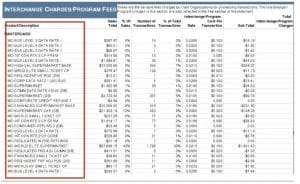
Below is how your interchange should be disclosed. If your statement includes this information, we can tell you whether your transactions are settling at the best possible rates or if there are settlement issues. We can also determine if your processor is inflating your interchange fees. For more, check out an article I wrote for Forbes on this exact issue.

Interchange plus credit card processing statement

How interchange should be displayed: an interchange-plus statement.

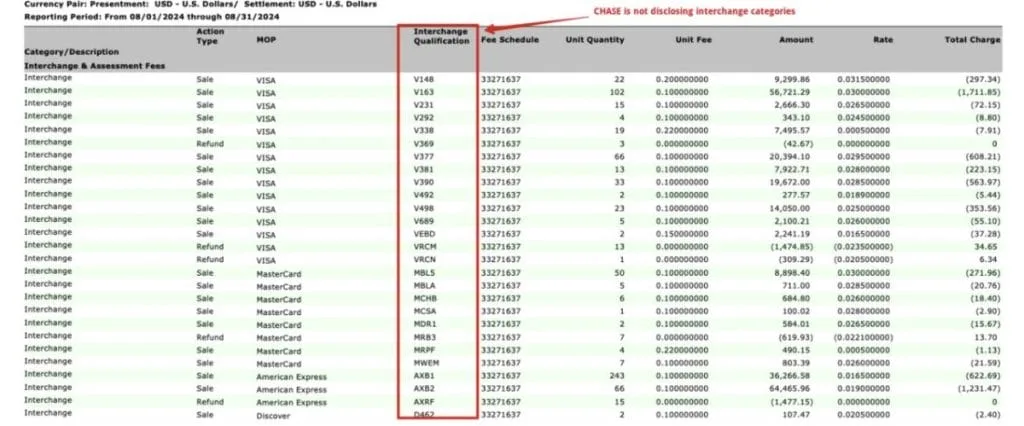
Now let’s take a look at a Chase Paymentech statement. Instead of providing the actual interchange category, such as “MC-BUS LEVEL 3 DATA RATE I,” they use a code like V148.

Did the transactions clear at the lowest interchange rate, or the highest? If you don’t know, how can you improve it? Are they inflating the interchange fees? I explore this further in the Forbes article.

Why are they hiding the interchange categories? Generally, things are hidden when someone does not want you to see something. Could it be that they are inflating or padding the interchange fees? Take a close look at the images below.

It would appear no one is going to earn a perfect score. Speaking of scores, check out your processor’s scorecard here.

Chase Paymentech Credit Card processing statement with hidden interchange categories

A Chase Paymentech statement where the interchange categories are masked behind secret codes.

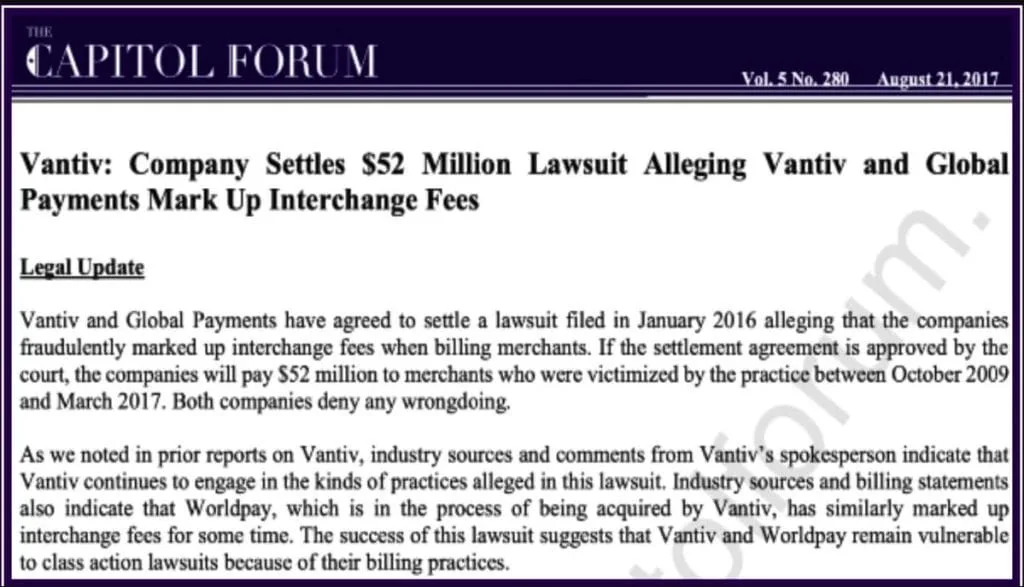
Vantiv, Worldpay, Global $52MM hush money Capitol Forum article clipping

Two of the largest credit card processors, now merged, settled for $52 million after being accused of inflating interchange fees. Even after settling, they maintained they did nothing wrong and would keep doing business as before.

We don’t have access to their secret code sheet. But we have seen so many of these statements that we believe we have a very good understanding of the most likely real interchange categories behind the codes.

Merchant processing is not regulated, which means any processor you deal with can hide fees, inflate them, or add made-up charges. If you are like most merchants, you have probably switched processors a few times, only to find yourself in the same situation: taken advantage of again.

40%Some of the largest companies in the world turn to us to navigate this. On average, our clients pay 40% less in fees after they start working with us.

Our guarantee

To be clear, we don’t sell credit card processing. We audit processors, negotiate, and vet agreements. Our guarantee is simple: if you find a company that saves you more money after hiring us, we will refund you double what you have paid us over the last six months. Everything we do is backed by our Love-The-Results-Or-Don’t-Pay Guarantee.

“A no-brainer.”

Kevin Harrington, original shark on Shark Tank

What to do if your statement is the coded kind

Three steps, and the first one costs nothing.

Worth knowing before you start: the fees on this statement do not reach your bank account itemised. They arrive as one debit, usually labelled BANKCARD MTOT DISC, which is the total of everything below with none of the detail attached.

Ask for a statement that names the interchange categories. Put it in writing. You want the category, the volume in each category and the fee charged for each. That is the same request any merchant on interchange plus should be able to make, and the response tells you a lot.

Get the codes translated. We do not have Chase Paymentech’s internal code sheet, and neither does anyone else outside the company. But we have seen enough of these statements to have a well-founded view of which real interchange categories sit behind the common codes, and our MADR engine runs that validation automatically.

Check for downgrades specifically. A downgrade means a transaction settled at a higher rate than it needed to. On a coded statement they are invisible by design, which is exactly why they persist for years.

Frequently asked questions

What is V148 on a Chase Paymentech statement?

It is an internal code, not an interchange category. Real interchange categories look like VI-US BUS TR3 PRD 3 or MC-BUS LEVEL 3 DATA RATE I. A code like V148 tells you nothing about how the transaction settled, which means you cannot check whether it settled correctly or whether the interchange was inflated.

Why are there two kinds of Chase Paymentech statement?

Some merchants get interchange fully disclosed by category, which is readable and auditable. Most get the coded version instead. If your statement shows codes rather than named categories, you are on the second kind and you cannot validate your own interchange from it.

What does EIRF mean on my statement?

Electronic Interchange Reimbursement Fee. In practice it often signals a missing or incorrect zip code, depending on your Merchant Category Code. It is one of the categories transactions downgrade into, and downgrades cost you money.

Can I ask Chase Paymentech for the real interchange categories?

You can ask, and it is worth asking in writing. What matters is whether you receive a statement format that names the interchange category, the volume in each category and the fees charged for each. Without those three you cannot verify anything.

How much of my bill is interchange?

Roughly 90% of total processing cost. That is why interchange is the part worth controlling. Shaving the processor markup while transactions keep downgrading is working on the small number.

Is my Chase Paymentech statement bad news by itself?

No. The coded format makes verification harder, not impossible, and plenty of merchants on it are priced reasonably. The point is that you cannot tell from the statement alone, which is a poor position to be in with 90% of your cost.

“A company not to be overlooked.”

Trevor Gleason, Treasurer of Facebook UK

See exactly what your processor is charging you, and whether it has been inflated. The audit is free, and it takes about five minutes to start.

Get My Free Auditor call 800-672-1292

Read More

Check out our other insights here

Bank of America Credit Card Processing: What It Costs and What to Watch
Bank of America logo

If Bank of America handles your credit card processing, go and pull your last three statements before you read any further. We have watched accounts at that bank move from four basis points to over forty, and the businesses paying it were told the new


View

Do You Have Risk Fees On Your Credit Card Processing Statement?

Man reading credit card processing statement

Do you have a “Risk Fee” on your credit card processing statement?

No? Good. You are luckier than a lot of merchants, and you should keep reading anyway.

View

Want to talk?

As seen on