



Chat with us, powered by LiveChat

BANKCARD MTOT DISC: What That Charge On Your Bank Statement Is

Business man reading credit card processing definitions.

MTOT DISC stands for Merchant Total Discount. It is your credit card processor sweeping an entire month of processing fees out of your bank account as one single ACH debit. The charge itself is normal and almost every merchant who takes cards pays one. What is not normal is that the debit tells you nothing about what is inside it.

If you are reading this, you probably opened your business checking account and found a line that looks something like BANKCARD 8001 MTOT DISC, with a date and a dollar amount and nothing else. No rate. No card type. No transaction count. No phone number. Just money gone.

This page explains what the descriptor means, what is actually inside that number, and how to check whether the amount is right. We are a merchant side auditing firm. We take no money from any processor, so we have no reason to tell you the charge is fine and no reason to tell you it is a scam. It is neither. It is a total, and totals are worth opening.

What each part of the descriptor means

The descriptor is three pieces of shorthand jammed together, which is why it reads like nonsense.

BANKCARD

This identifies the debit as a card processing charge. It is the originator name attached to the ACH withdrawal, not the name of the company you signed with. Your processor’s brand name usually does not appear anywhere on the debit.

The four digit number

Descriptors often carry a number, such as BANKCARD 8001 or BANKCARD 8710. This is an internal batch or originator identifier. It is not your merchant number, it is not an account you can look up, and calling your bank about it will not get you anywhere. Your bank did not charge you. Your bank simply honored a debit that your processor originated.

MTOT DISC

MTOT is merchant total. DISC is discount, which in this industry means fees rather than savings. The discount rate is the percentage your processor keeps, and it has always been an unfortunate name for it. So MTOT DISC is the merchant’s total fees for the period, collected in one movement.

The single most useful thing to understand about this line is that it is a sum, not a fee. Nobody charged you one fee of that amount. Dozens of separate charges were added together and then withdrawn at once, and the addition happened on a document you were never handed.

No, a company called Bankcard USA is not debiting you

This is the most common wrong turn merchants take, and it costs people hours. Because the descriptor leads with the word BANKCARD, business owners search the term, find a company that uses Bankcard in its name, and conclude that an unfamiliar business is pulling money out of their account.

Unless you specifically signed a merchant services agreement with that company, it is not them. The word is generic. It describes the type of transaction, the same way an ACH descriptor might say PAYROLL or UTILITY. Chasing a company you have never done business with is a dead end, and it delays the only step that actually resolves this, which is opening your processing statement.

The related descriptors, and which ones are money coming in

The same shorthand shows up in several combinations, and telling them apart matters because some are deposits and some are charges.

  • MTOT DISC is a charge. Merchant total discount, your monthly fees leaving the account.
  • MTOT DEP is a deposit. Merchant total deposit, your monthly card sales arriving.
  • BTOT DEP is a deposit. Batch total deposit, a single day’s settled batch arriving, usually one per business day.
  • MERCH BANKCARD and MERCH FEE variants appear on other platforms and mean broadly the same thing as MTOT DISC.

If your fees are being netted out of your deposits rather than debited separately, you may never see an MTOT DISC line at all. That is worth knowing, because it is the arrangement where fees are hardest to notice. Money you never received is much easier to overlook than money that visibly left.

What is actually inside one of these debits

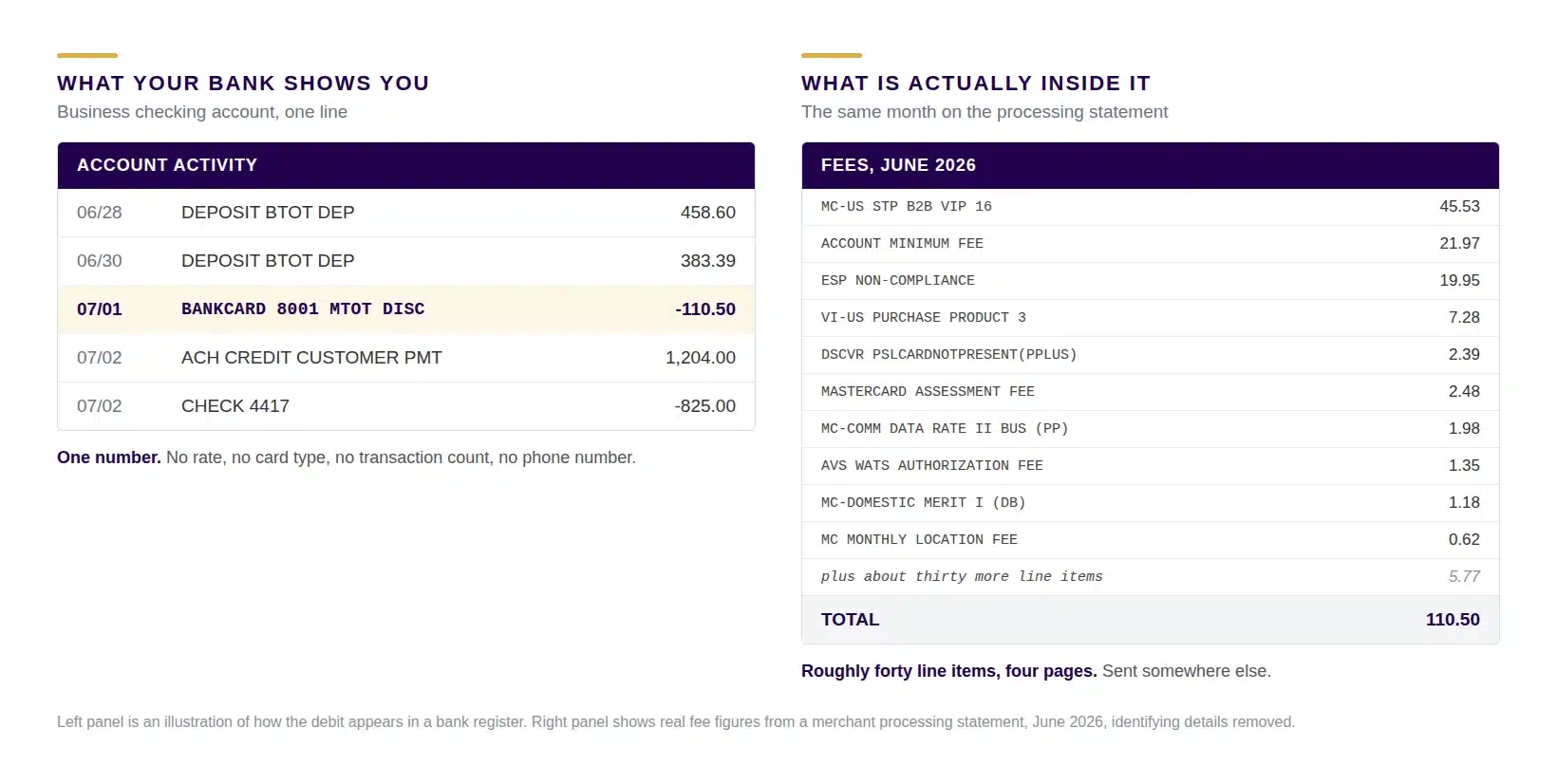
Here is a real one. A medical supply distributor, June 2026, statement figures unchanged and identifying details removed.

They ran 27 card transactions totaling $2,270.73 that month. Their fees came to $110.50, and that $110.50 is what appeared on their bank statement as a single debit. Behind it sat roughly forty separate line items spread across four pages, including:

Side by side comparison showing a single BANKCARD 8001 MTOT DISC debit of $110.50 in a bank register next to the roughly forty separate fee line items on the processing statement that add up to it
Left, an illustration of how the debit appears in a bank register. Right, real fee figures from a merchant processing statement, June 2026, identifying details removed.

Look at the two largest non interchange items. An account minimum fee of $21.97 and a non-compliance fee of $19.95 come to $41.92, which is 38 percent of the entire bill, and neither one has anything to do with processing a card. The minimum fee is a penalty for not spending enough. The non-compliance fee is a penalty for a paperwork status the merchant may well have satisfied already and simply never been credited for.

You could calculate an effective rate here and get 4.87 percent, which looks alarming. We would not lead with that number, because on a $2,270 month two fixed penalties distort it beyond usefulness. The honest read is not the rate. It is the composition. More than a third of what left this account was not the cost of accepting payment, and the bank statement showed none of it.

Both of those penalty lines are fixable, and neither one requires changing processors. Non-compliance fees in particular are frequently charged to merchants who were never given a working path to compliance in the first place. We wrote about that separately in what to do about a non-compliance fee you may not owe.

The document you never open is where your pricing changes

There is a second reason the one line debit matters, and it is the one that costs merchants the most money over time.

That same distributor’s statement carried two notices in a block near the top of page one. One announced that a network chargeback representment fee was rising from $22.00 to $30.00. The other announced a new $12.00 per terminal charge, assessed every thirty days, on terminals judged to be configured improperly. The notice closed by stating that continuing to use the merchant account after thirty days represents acceptance of the new terms.

Read that again. Your pricing changes by notice, your silence is treated as agreement, and the clock starts running on a document that lands in a portal or an envelope you have no reason to open, because the only thing that reaches your actual bank account is a number with no explanation attached to it.

You cannot dispute what you do not see. The bank statement gives you one number. The four page document that explains it, and that quietly changes your pricing, is somewhere else entirely.

How to check whether your MTOT DISC is right

This takes about fifteen minutes and you can do all of it yourself.

1. Get the statement that matches the debit

Find the processing statement for the same month. It usually lives in an online portal rather than your inbox. If you cannot locate it, call the customer service number printed on any past statement and ask for PDF statements to be emailed monthly from now on. Ask for twelve months of back statements while you have them on the phone.

2. Match the total first

The statement’s total fees figure should equal the debit that hit your bank account to the penny. If it does not, stop and find out why before looking at anything else. A mismatch is either a timing difference or a problem, and you want to know which.

3. Separate the fixed charges from the transaction charges

Most statements group these. Fixed monthly items such as minimums, statement fees, compliance fees, terminal fees and location fees are the ones you can act on quickest, because they are charged regardless of what you process and they are usually the easiest to challenge.

4. Look for names that do not appear in your agreement

Interchange categories and network assessments are real and are set by Visa, Mastercard, Discover and American Express. Everything else on the page is your processor’s own pricing, and some of it is invented outright. Our statement decoder covers the real fee names one by one, and this article on merchant account fees covers how to tell a genuine network charge from a made up one.

5. Compare two months side by side

This is the step that finds the most money and almost nobody does it. Put this month next to a month from a year ago. New line items appear quietly, rates drift upward, and categories get renamed. A single debit on a bank statement hides all three, because the total can stay roughly flat while its contents change completely.

A word on everything else you found searching this

If you searched MTOT DISC before landing here, you likely read several other explanations. It is worth knowing that nearly every one of them was published by a company that sells merchant accounts. Some are processors and some are sales organizations that resell for processors, and several include a line warning you that anyone describing this charge as unfair is only trying to win your business.

They are half right. The charge is not inherently unfair, and we are not going to tell you it is. But a firm that earns money from processing volume has no incentive to walk you through the forty line items behind the number, because that is where its own margin sits. We are paid a flat fee by merchants, we keep none of what we find, and we take nothing from any processor. That is the only reason this page bothers to open the total up.

Frequently asked questions

What does MTOT DISC stand for?

MTOT DISC stands for Merchant Total Discount. It is the combined total of your card processing fees for the period, withdrawn from your bank account as a single ACH debit. Discount in this context means the fees your processor keeps, not a reduction in price.

Is BANKCARD MTOT DISC a legitimate charge?

Yes, in the sense that it is a real charge from a processor you have an agreement with, not fraud. Whether the amount is correct is a separate question, and it can only be answered by comparing the debit against the processing statement it came from.

Who is charging me if I do not recognize the name?

Your credit card processor. BANKCARD is a generic descriptor for card processing activity and does not name the company. Check which processor your business boarded with, then find that month’s statement. Your bank cannot tell you more than the descriptor shows.

Is this Bankcard USA charging my account?

Almost certainly not. Unless you signed a merchant agreement with that specific company, the word bankcard in the descriptor is generic and refers to card acceptance, not to any business with bankcard in its name.

What is the difference between MTOT DISC and MTOT DEP?

MTOT DISC is money leaving your account, your monthly processing fees. MTOT DEP is money arriving, your monthly card sales. BTOT DEP is a single day’s batch of sales arriving. Discount means fees, deposit means sales.

How much should MTOT DISC be?

There is no single right number, because it depends on your volume, your card mix and your pricing arrangement. A total on its own tells you very little. What tells you something is the breakdown, particularly how much of it is fixed monthly charges rather than the cost of accepting the cards you actually ran.

Can I stop the charge from being debited automatically?

Generally the automatic debit is a term of your merchant agreement, so it is not something you can simply switch off. Banks do offer ACH debit blocks, ACH filters and ACH positive pay, which control what is allowed to debit an account. Speak to your bank about the options before making any change, since blocking a processor’s debit without arranging an alternative can put your account in default.

What should I do if the amount looks wrong?

Start with the statement rather than the phone. Identify the specific line items you are questioning, check them against your agreement, and note when each first appeared. Merchant agreements commonly give you a limited window to object to a new fee before continued use is treated as acceptance, so timing matters.

Want someone to open the total for you?

Send us a statement and we will tell you exactly what is inside that debit, line by line. The audit is free. If there is nothing there, you spent five minutes finding out.

Get a free audit

Related reading: credit card processing fees explained, find the overbilling in a real statement, credit card processing definitions, and our processor scoreboard.

This page is general information about billing descriptors and is not legal, accounting or financial advice.

Read More

Check out our other insights here

Credit Card Processing Fees Explained: 5 Things Your Processor Will Not Tell You
Credit Card Fees Explained

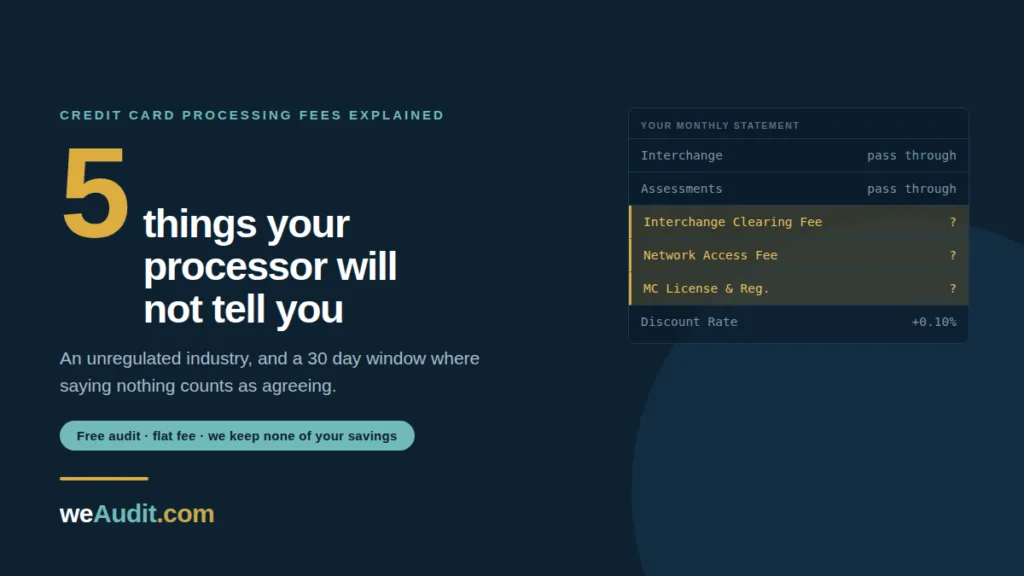
Most merchants have credit card processing fees explained to them exactly once: on the day they sign. After that, the bill changes on its own. Rates drift, new line items appear with official sounding names, and the one page that would explain it never arrives.


View

How to Read Your Chase Paymentech Statement

Chase Bank Logo

What makes Chase Paymentech statements hard to read
Before you spend time on an article that may not apply to you: Chase Paymentech runs two kinds of statements, a “Have” and a “Have Not.”

View

Want to talk?

As seen on