


Chat with us, powered by LiveChat

Credit Card Processing Fees Explained: 5 Things Your Processor Will Not Tell You

Credit Card Fees Explained

Most merchants have credit card processing fees explained to them exactly once: on the day they sign. After that, the bill changes on its own. Rates drift, new line items appear with official sounding names, and the one page that would explain it never arrives.

That is not an accident, and it is not incompetence. The industry built its pricing model this way on purpose. What follows are five things about merchant processing fees that your processor has no commercial reason to tell you, drawn from more than a decade inside the industry as an executive at Fifth Third Processing Solutions, and from seventeen years since spent auditing statements on the other side of the table.

None of it requires you to be a payments expert. All of it is checkable on the statement sitting in your inbox right now.

Credit card processing fees explained: the three layers of your bill

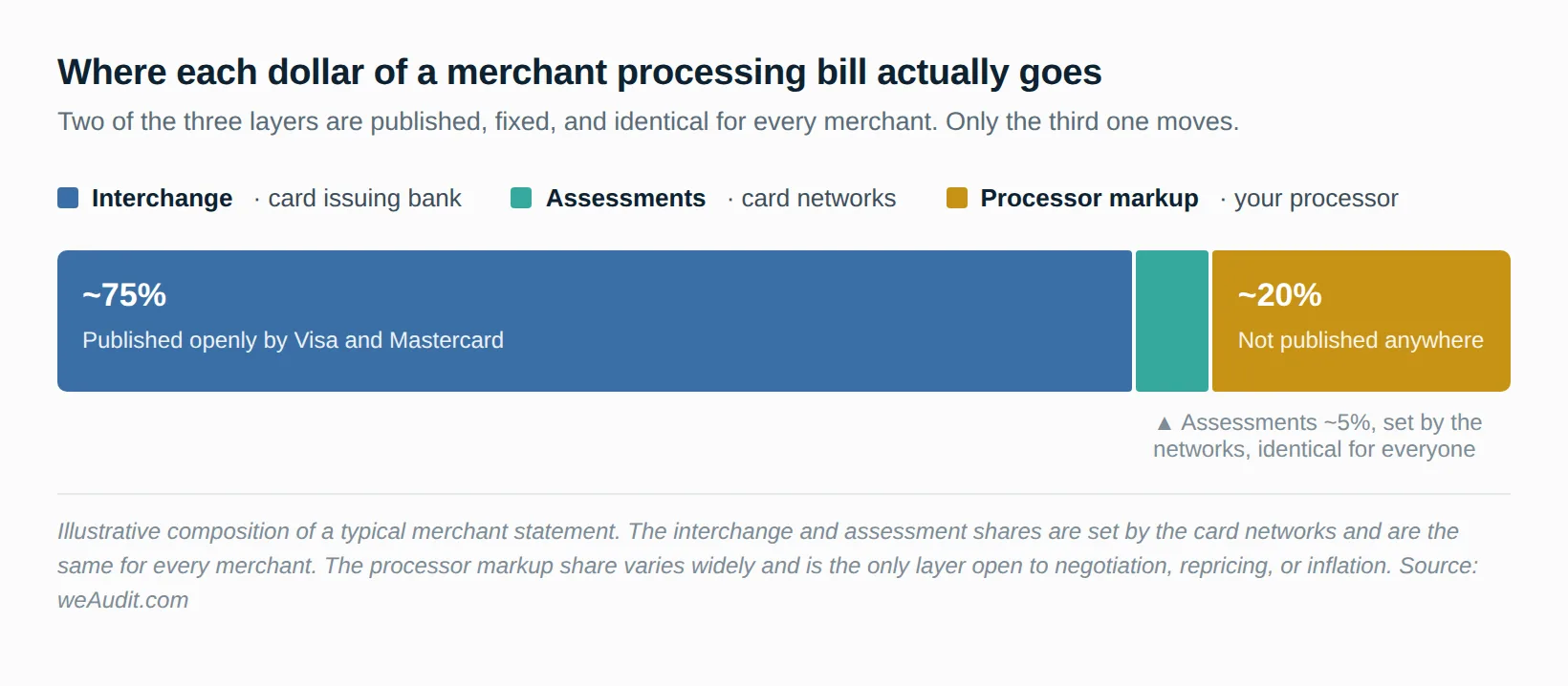
Every dollar you pay to accept a card falls into one of three buckets. Processors rarely separate them for you, because the moment you separate them yourself, it becomes obvious which part belongs to whom.

Interchange
Goes to the bank that issued your customer’s card. Roughly 70 to 80 percent of a typical bill. Published openly by Visa and Mastercard. Your processor keeps none of it.
Assessments
Goes to the card networks themselves. Small, published, and the same for everyone. Your processor keeps none of this either.
Processor markup
Everything else. Not published anywhere. Not capped by anyone. No regulator has ever reviewed it. This is the entire negotiation, and it is the part that moves.
Credit card processing fees explained as a single bar: interchange about 75 percent, assessments about 5 percent, and processor markup about 20 percent of a merchant bill
Two of the three layers are fixed and published. The third is the entire negotiation.

Hold on to that third box. Every one of the five points below is a way of making the third box bigger without ever renegotiating the rate you agreed to.

1. Merchant processing is an unregulated industry

There is no federal agency that reviews what your processor charges you. No rate filing. No licensing body that audits merchant statements. Banking has regulators, insurance has regulators, securities have regulators. Merchant processing has none of that. A processor can price a merchant however it likes, and it answers to nobody but the merchant who is not reading the statement.

Then there is the moving target on top of it. Visa, Mastercard, Discover and American Express all publish program and pricing updates twice a year, in April and October, and the PIN debit networks do the same. April 2026 alone brought Visa eliminating the Level 2 interchange program for business cards, Mastercard introducing a Fallback Avoidance fee and a Force Post Transaction Fee, Discover revising hotel and car rental interchange, and American Express reworking OptBlue pricing thresholds with new small and micro ticket tiers. That is one release, in one month.

Across a full year, the rules, categories and rates that determine your bill change by the hundreds. No operator running a business has the time to track that, and the processor knows it.

$187.2B
Total card processing fees paid by US merchants in 2024, an all time record. Source: The Nilson Report.
2x a year
Every April and October, all four card brands plus the PIN debit networks reprice at once.

weAudit updates its own detection software against every release. Even then, no software catches everything, which is why every statement we review still gets read line by line by a human being. Our auditors train for two years before they may certify a single audit. That is not a sales point, it is a measure of how deliberately complicated this has become.

2. You are almost certainly not locked in

The most effective retention tool in this industry is not a contract. It is a sentence: “your ERP only works with us,” or “that gateway is required for your platform.”

Sometimes that is true. Roughly nine times out of ten, it is not. Either the options exist and were never mentioned, or a piece of middleware sits between your system and the processor and gives you a free choice of who is on the other end. Gateways and processors are separable in most modern stacks, and the merchants who find that out usually find it out from someone other than their processor.

This matters more than it looks. Most merchants who finally get credit card processing fees explained honestly discover the explanation came with a switch they were told they could not make. Ask why the answer serves them. If your current setup is highly profitable to the incumbent, “you have no choice” is a claim with a motive behind it, and it deserves to be verified rather than accepted.

Before you accept that you are stuck, check the gateway independently. Our Gateway Scorecards rate Authorize.net, NMI, Cybersource, Stripe, Paytrace, PayPal Payflow Pro and Shift4 on what they actually cost and what they lock you into, and the Processor Scoreboard does the same for about thirty processors.

3. Downgrades are not random, and they are not your fault

A downgrade happens when a transaction fails to qualify for the interchange category it should have earned, and settles at a more expensive one instead. Processors usually call this the cost of doing business, or a data problem on your end.

Configuration causes downgrades. Three settings do most of the damage.

The wrong account setup

Merchant category code, account type, or a business classification that does not match how you actually sell. A B2B merchant boarded as retail will never see the commercial interchange rates it qualifies for.

The wrong gateway

Some gateways cannot pass the data fields that qualifying transactions require, or nobody configured them to send those fields. Your transaction is fine. The pipe it travels through is not.

The wrong interchange flags

Level 2 and Level 3 data, address verification, authorization timing, settlement windows. Each one is a flag your processor either sends correctly or does not. When it does not, the transaction downgrades and nobody tells you.

Here is the part that matters, and it is the part nobody has credit card processing fees explained to them at signing. Every one of those is set on the processor’s side, and the processor earns more when they are set wrong. Downgraded transactions carry higher fees, higher fees mean higher margin, and higher margin means bigger commissions. There is no incentive anywhere in that chain to configure your account correctly, and no regulator checking whether they did.

What you are told
“Downgrades happen. Some of your customers use rewards cards, and there is nothing anyone can do about that.”
What is often true
A fixable setting is costing you a percentage point on a slice of your volume, every month, and it has been doing so since the day you were boarded.

4. Your processor can raise your fees whenever it wants

This is not a loophole. Your agreement says so, in plain language. A typical merchant processing agreement contains a clause that reads like this:

“26.5. Subject to Section 31.3, we may also increase our fees or add new fees for Services for any reason at any time…”

Read that again. For any reason. At any time. Some agreements promise notice. Not all of them do. And when notice does arrive, it arrives as a paragraph of legal text in the middle of a statement, using terminology chosen specifically to sound like it came from somewhere else.

Fee names that sound official but are not

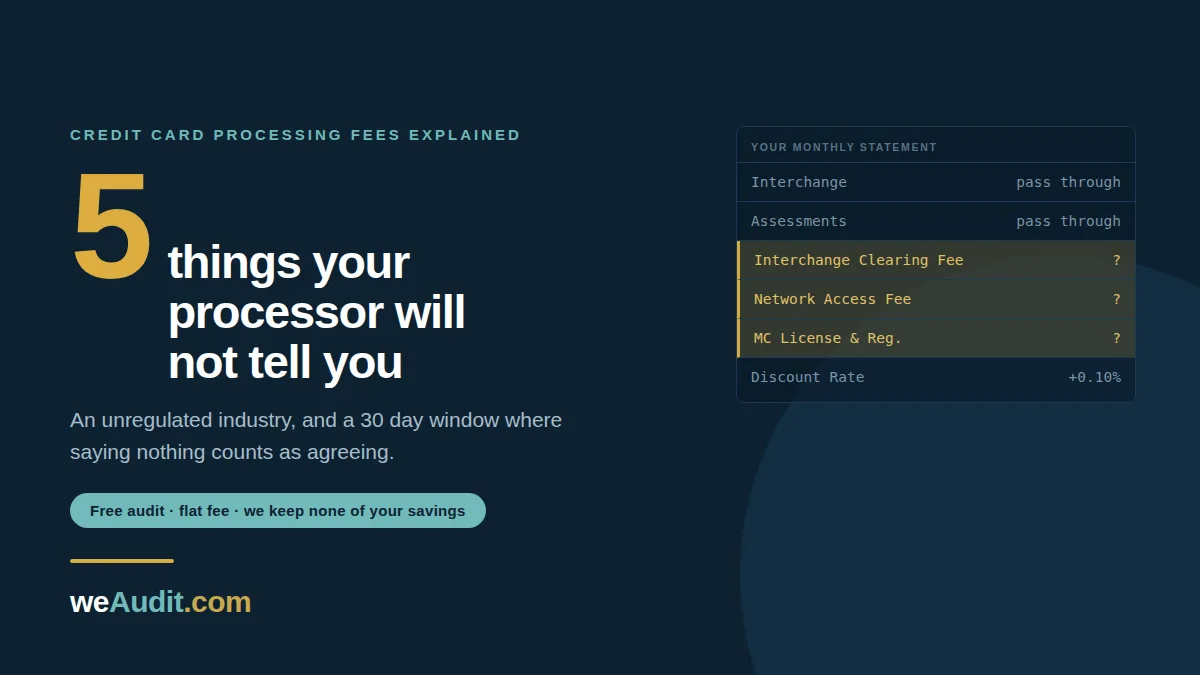
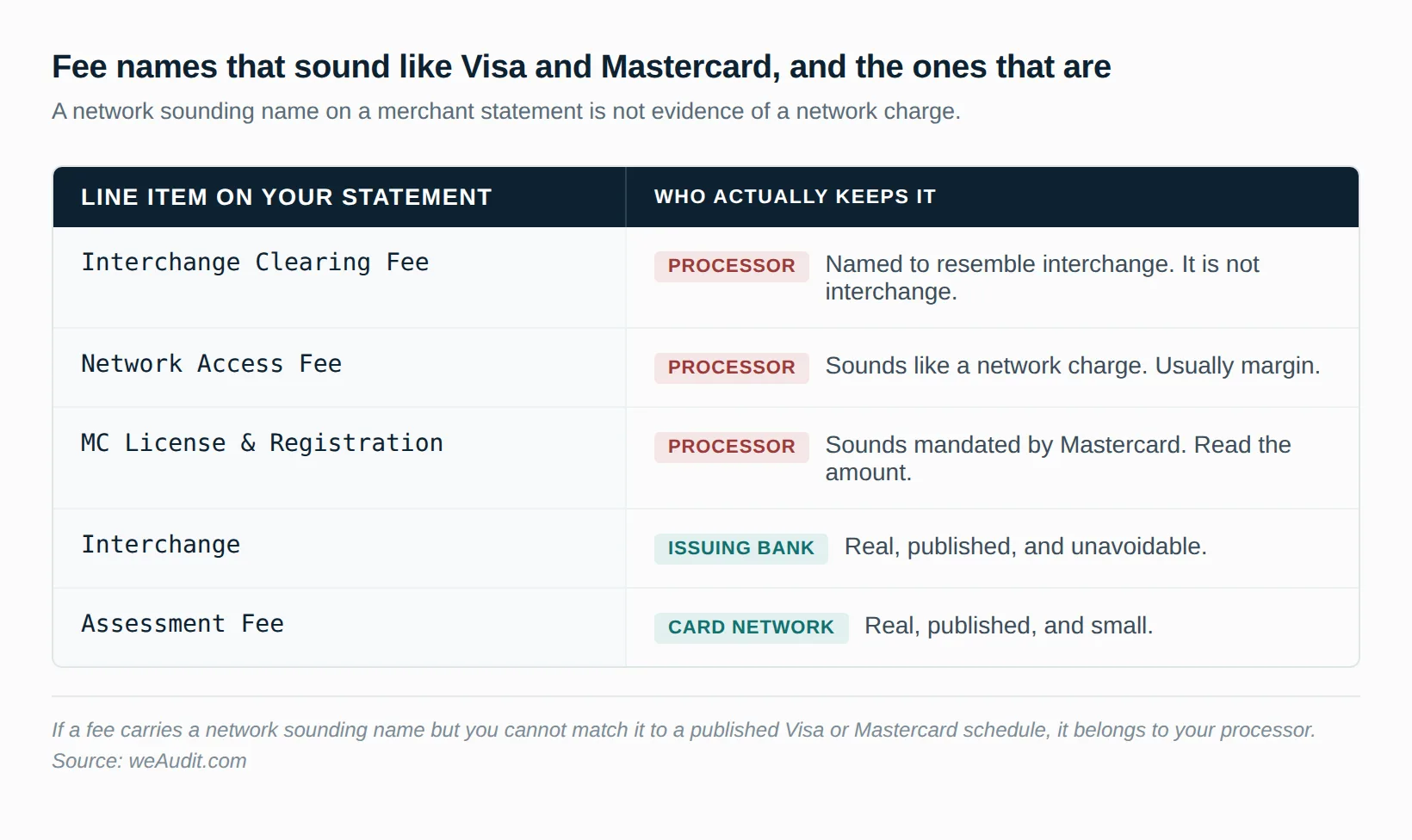
An interchange clearing fee is a good example. It sounds like interchange, which is a real network cost you cannot avoid. But it is not interchange at all. It is a processor line item wearing a borrowed name. The same trick shows up across the industry:

Interchange Clearing Fee  sounds like Visa or Mastercard. It is not.
Network Access Fee  sounds like a network charge. Often processor margin.
MC License & Registration  sounds like a Mastercard requirement. Read the amount.
Assessment Fee  this one is genuinely a network charge, and it is small.
Interchange clearing fee, network access fee and MC license and registration shown as processor charges beside real interchange and assessment fees
A network sounding name is not evidence of a network charge.

The pattern is consistent: a low discount rate wins the deal, and the processor rebuilds its margin afterward through line items that read like somebody else’s fee. Nothing about the headline rate you negotiated has to change for your cost to climb.

If you want to know what a specific line on your bill actually is and who keeps it, the Statement Decoder breaks down the fees by name, one at a time.

5. Your silence is treated as consent

The increase itself is only half of it. The other half is how they write the notice, and what happens when you say nothing. Here is real language, buried in a block of text on a monthly statement:

“Based upon recent card organization changes as well as our own pricing considerations, effective on or after October’s month-end billing, your discount rates for Visa, MasterCard, Discover, PIN Debit, and American Express Full Acquiring transactions, as applicable, will increase by 0.10%. An increase of 0.10% represents a fee increase of 10 cents per $100 in sales…

Continuing your merchant account with us or use of your merchant account after 30 days will constitute your acceptance to these terms.

Emphasis added. The original does not emphasize any of it.

There are three separate moves in that paragraph.

“Card organization changes” points the finger elsewhere

Network changes are real. The networks schedule them and publish them every April and October. But a genuine network change never lands as a single uniform increase applied identically to Visa, Mastercard, Discover, PIN debit and American Express all at once. Interchange moves by category, by card type, by transaction. A flat 0.10 percent across all five brands is not a pass through of anything. It is a price increase, and the clause even admits it: “as well as our own pricing considerations.”

“Just 10 cents per $100” hides the real multiple

Framed against sales, 0.10 percent sounds trivial. Framed against what you were paying, it often is not. If your markup was 0.05 percent, adding 0.10 percent did not raise your fee by a tenth of a percent. It tripled it. The percentage looks small next to your revenue and enormous next to their margin, and the notice invites you to compare it to the wrong number.

$5,000
What a “trivial” 0.10 percent increase costs a merchant doing $5 million a year in card volume. Every year, compounding with volume, from one paragraph nobody read.

The 30 day window converts inaction into agreement

You have 30 days to object. Miss it, and simply continuing to run your business counts as accepting the new price. Most merchants never see the notice, which means the mechanism works exactly as designed: the disclosure satisfies the contract and defeats your attention at the same time.

The ten minute check: credit card processing fees explained on your own statement

You do not need us to find out whether something is wrong. Pull your last three monthly statements and do this:

Step 1. On each statement, find total fees charged and total card volume processed.

Step 2. Divide total fees by total volume. That is your effective rate for the month.

Step 3. Compare the three months against each other.

What you are looking for: an effective rate that is climbing while your business has not changed. A stable mix of customers and card types should produce a stable effective rate. If it is drifting upward month over month, something moved, and it was not you.

That single number cuts through every naming trick in this article, because it does not care what a fee is called. It only cares what left your bank account. It is also the fastest way to get credit card processing fees explained to yourself without anyone selling you anything.

What the effective rate will not tell you is which of the five things above is causing it. That takes a line by line review against the current network schedules, which is the part that takes trained people and updated software.

Frequently asked questions

What are credit card processing fees?

People asking what are credit card processing fees usually want one number, and there is not one. Credit card processing fees are the total cost of accepting a card payment, and they come in three layers. Interchange goes to the bank that issued your customer’s card and is roughly 70 to 80 percent of a typical bill. Assessments go to the card networks and are small and identical for everyone. The third layer is your processor’s markup, which is not published, not capped, and not reviewed by anyone. When merchant services fees explained by a salesperson sound simple, it is usually because the third layer was left out.

Is credit card processing regulated?

No. Merchant processing is an unregulated industry. There is no agency that approves processor pricing, no rate filing requirement, and no regulator auditing merchant statements. The Durbin Amendment caps debit interchange for large issuers, and other rules govern consumer facing card terms, but only your merchant agreement governs what a processor may charge your business to accept cards.

Is credit card processing a scam?

No. Card acceptance is a real service with real costs, and interchange and assessments are legitimate charges that your processor passes straight through. The problem is narrower and more specific: in an unregulated market, a processor can raise the markup layer at will, rename it to resemble a network cost, and inflate it through account settings you cannot see. That is not fraud in most cases. It is a pricing model working exactly as designed, and it is why credit card processing scams and merchant services scams are searches so many business owners end up running before they ever look at the statement itself.

What is an interchange clearing fee?

Despite the name, an interchange clearing fee is generally not interchange and is not a Visa or Mastercard charge. It is a processor line item named to resemble one. Interchange goes to the card issuing bank, and the networks publish those rates openly. If a fee on your statement carries a network sounding name but you cannot match it to a published schedule, it belongs to your processor.

Can my processor raise my rates without asking me?

In most cases, yes. Standard merchant agreements include a clause allowing the processor to increase fees or add new fees at any time. A paragraph on your monthly statement usually satisfies that notice requirement, and using the account past a stated window, commonly 30 days, counts as acceptance. You agree by not noticing.

How do I know if I am being overcharged?

Start with the effective rate check above. A rate that rises while your business stays the same is the clearest signal available without a full review. Beyond that, look for fees that appeared without explanation, PCI related charges you were never given a path to avoid, and category names that echo Visa or Mastercard terminology. Our real statement walkthrough shows what $80,785.60 of hidden charges looks like on an actual five page bill.

Can I get money back for past overbilling?

Sometimes, yes. Overcharges are not always only a going forward problem, and you can sometimes recover amounts a processor already took. See credit card fee refund and recovery for how that works, and PCI non-compliance fee refunds for one of the most commonly recoverable charges.

What does a processing audit cost?

The initial audit is free. If we find nothing, you spent a few minutes finding out. weAudit charges a flat fee rather than a percentage of what it saves you, and we cover the whole pricing question at what a credit card processing audit costs.

We do not take a percentage of your savings. Every firm in this space will offer to get your credit card processing fees explained. Ask what happens to their fee if your bill goes down and stays down. Firms that take a cut of what they find have an interest in the leak continuing. The processor already took too much out of this account. We are here to fix it, not to take the next slice of it.

Find out if you are being overbilled

A free audit. No strings, no credit card, nothing to sign. Most reviews are complete in three to four weeks, and some end with a check for charges already taken.

Get My Free Audit

or call 800-672-1292

Sourcing: card processing fee totals from The Nilson Report. April and October network release details from published Visa, Mastercard, Discover, American Express and PIN debit network updates. Contract and rate increase language quoted from merchant processing agreements and statement notices reviewed by weAudit. Last updated August 2026.

Read More

Check out our other insights here

Warning If You Use Bank of America For Credit Card Processing

View

Do You Have Risk Fees On Your Credit Card Processing Statement?

Man reading credit card processing statement

View

Want to talk?

As seen on