What Are Interchange Fees? (And Why Your Processing Bill Keeps Climbing When They Haven’t)
Credit card interchange fees are the single largest, and most misunderstood, line item on your processing bill. They’re the fee your bank pays the cardholder’s bank every time a customer pays with a card, and the card networks (Visa, Mastercard, Discover, American Express) set them. Here’s the part almost no one tells you: interchange is a pass-through cost. It’s the same for every processor. So when your processing bill keeps climbing, interchange usually isn’t the reason. What’s stacked on top of it is.
This guide explains what interchange really is, why the popular story about it is mostly a myth, and where your money is actually going.
How do interchange fees work?
When a customer taps or swipes a card, money moves through four parties:
Customer → Your bank (the acquirer) → the card network → the customer’s bank (the issuer)
Interchange is the slice that leaves your account and lands at the cardholder’s bank, the institution that issued the card and takes on the risk of extending credit. It is not money your processor keeps. That distinction is the key that unlocks everything else on this page.
Who actually sets interchange (it isn’t your processor)
Visa and Mastercard publish their interchange rate schedules twice a year. Your processor does not set these rates, cannot discount them, and pays the exact same interchange you do. Any salesperson who implies they have a special pipeline to “wholesale interchange” or can “lower your interchange” is selling you the first myth in the business. Interchange is the floor. It’s identical no matter whose logo is on your statement.
What is different from one processor to the next is everything they add on top, and that’s where the games are played.
The three parts of your processing bill
Break your effective rate into its three real components and the whole picture snaps into focus:
1. Interchange: set by the networks, paid to the issuing bank. Fixed. Non-negotiable. The same for everyone.
2. Assessments: the networks’ own fees for running the rails. Also fixed and small.
3. Processor markup: what your processor charges for its service, plus a long tail of ancillary fees: statement fees, PCI fees, “non-compliance” fees, batch fees, monthly minimums, early termination fees, and more.
Only one of those three is negotiable, removable, or manipulable: the markup. Roughly two-thirds of your bill (interchange plus assessments) is a fixed pass-through that no processor controls. When your costs go up, the honest question isn’t “why did interchange rise?” It’s “what did my processor do to the third bucket?”
The myth: “Interchange fees keep going up”
Ask almost any business owner and they’ll tell you interchange has gone through the roof. News outlets repeat it. It’s the reason thousands of businesses have turned to surcharging their own customers. There’s just one problem: as a rate, it isn’t really true.
Look at what actually happened over the last decade and a half. According to the U.S. Government Accountability Office’s analysis of Visa and Mastercard rate schedules, and the networks’ current published rates:
| What | 2009 | Today | Change |
|---|---|---|---|
| Mastercard interchange ceiling | 3.25% | ~3.30% | +1.5% |
| Visa interchange ceiling | 2.95% | ~3.15% | +6.8% |
| General consumer prices (CPI) | n/a | n/a | +50% |
| A first-class postage stamp | 44¢ | ~80¢ | ~+80% |
| Employer family health premium | $13,375 | $26,993 | +102% |
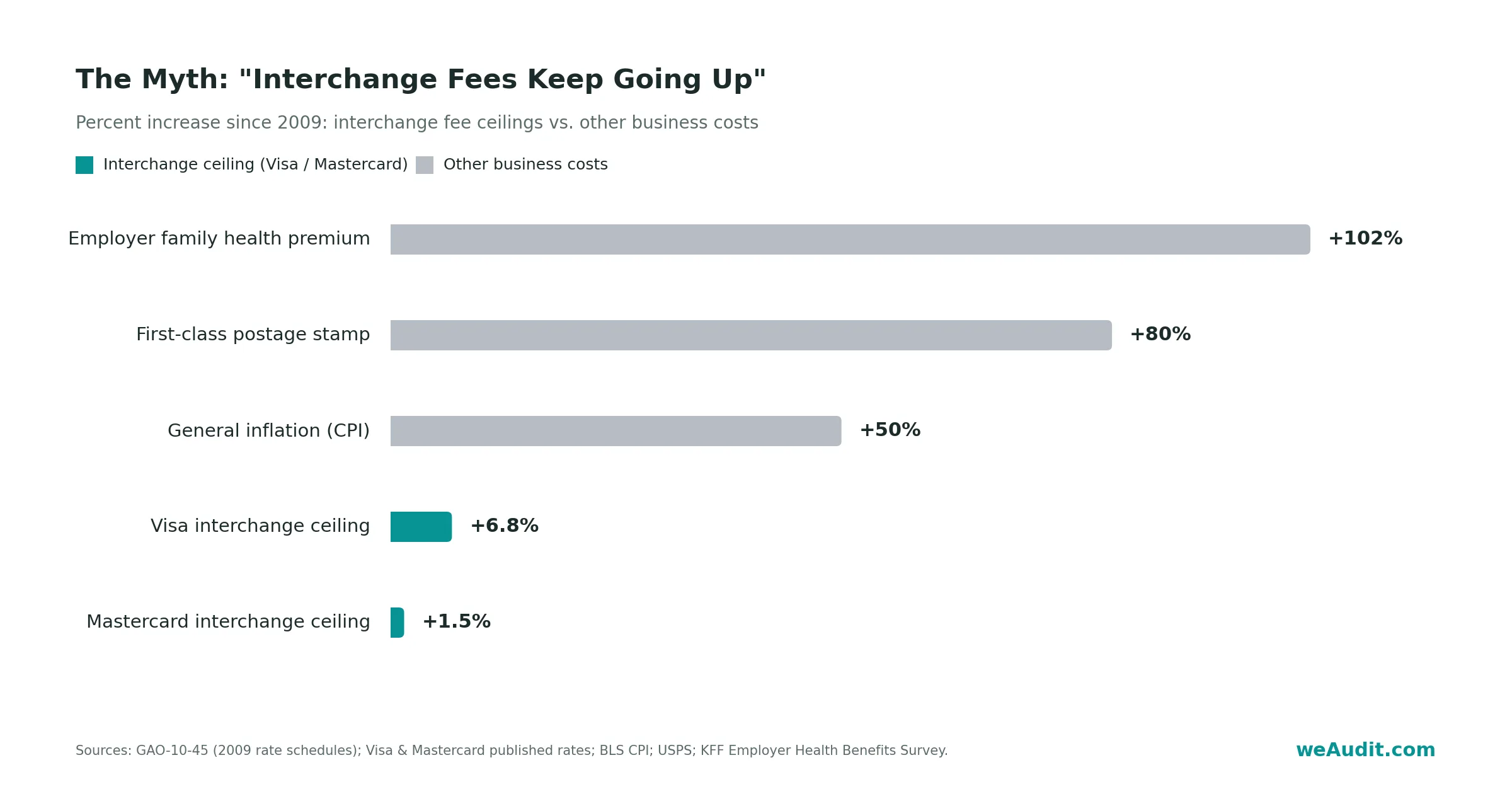
Read that again. Over the same sixteen years in which the cost of nearly everything a business pays for rose fifty to a hundred percent (health insurance more than doubled), the highest interchange rate Mastercard can charge moved by five one-hundredths of a percentage point. Visa’s rose less than a fifth of a point. The lowest interchange rates in the schedule actually went down.
Here’s the line that should end the debate: had interchange merely kept pace with inflation like every other cost you carry, Mastercard’s ceiling would be roughly 4.9% today instead of 3.30%. Measured against the real world, interchange hasn’t climbed. It has effectively gotten cheaper.
There’s a structural reason for this that reframes the whole argument. Interchange is charged as a percentage of the sale. That means it’s already inflation-proof by design. When your prices rise, your ticket sizes rise, and the networks’ cut grows automatically, without anyone touching the rate. The networks never needed to raise the percentage. Inflation raises their revenue for them. So when a merchant says “my interchange keeps going up,” what’s almost always happening is inflation showing up in bigger tickets, not a rate hike.
So why is your bill higher?
One reason, and it’s the one nobody wants to talk about: your processor.
While interchange sat still, processors found two ways to make you pay more. The obvious one is padding their own markup and the ancillary fees in that third bucket: statement fees, PCI fees, “risk” fees, and the rest. The second is subtler and far more damaging: they inflate the interchange itself. Not by changing the rate, which they can’t, but by setting your account up so your transactions settle at the wrong, higher interchange category. Both happen in a corner of the financial world that almost nobody regulates.
How your interchange gets inflated (the trick almost no one sees)
Here’s the part almost no merchant knows: the interchange rate is fixed, but which rate your transaction actually settles at is not.
Every card network publishes dozens of interchange categories, and each transaction is supposed to fall into a specific one based on how your business is classified and how the sale is processed. Which category it lands in depends on things your processor controls: your MCC (the Merchant Category Code that tells the network what kind of business you are), the interchange qualification flags, the data passed with each sale, and the gateway your transactions run through. Get any of those wrong, and the transaction “downgrades”: it settles at a higher, more expensive interchange category than it ever should have.
Think of it like handing a math test to your history teacher. Every answer can be 100% correct, and every one is still marked wrong, because they’re answers to the wrong questions. Your transactions can process flawlessly and still cost you more interchange than you owed, simply because the account was built to ask the wrong question every single time.
So why would a processor let that happen? Four reasons, and I’ve seen all four, every day.
1. There is no bar to clear. To sell you a single dollar of a mutual fund, a person has to hold licenses and pass exams. To set up a merchant account that moves tens of millions of dollars a year, one that can quietly cost you millions, the requirement is nothing. No license. No exam. No training. The person configuring your account may have been waiting tables last week. A great deal of the overbilling we find starts right here: honest mistakes made by people the industry never required to know better.
2. The “risk fee.” Many processors build in a surcharge that, read closely in the agreement, simply means the transaction didn’t settle at the lowest rate. Set the account up so transactions downgrade, and the processor collects that fee on every one. Setting you up wrong, in other words, can be more profitable than setting you up right.
3. The issuing-bank incentive. When your processor is also a bank that issues cards, it earns the interchange on its own cards. Every downgrade sends more interchange straight back to that bank. The bigger the issuer, the more it makes when your transactions land in the wrong category, which means it is motivated, and compensated, to make sure you aren’t set up correctly.
4. The wrong gateway. Processors route merchants onto their own gateway, or simply the wrong one for the business. Sometimes that’s ignorance. Sometimes it’s deliberate, because the wrong gateway earns them more. Either way, the question is the same one that runs through this entire industry: who is checking to make sure they don’t?
The answer, as we’re about to see, is almost no one.
The story that isn’t being told: processor deception
Credit card interchange is set by two of the most scrutinized companies on earth. Merchant processing, by contrast, operates with remarkably little oversight, and a track record of enforcement actions and settlements that tells you exactly why costs have crept up. These aren’t hypotheticals. They’re matters of public record.
The FTC took action against this nationwide processor and two of its sales-agent affiliates, alleging it trapped small businesses with surprise fees. According to the FTC, First American concealed that merchants were signing a three-year, auto-renewing contract carrying a $495 cancellation fee, kept withdrawing money from merchants’ bank accounts even after they’d cancelled, sometimes disguising the debits by changing the company name attached to them, and handed out “savings” projections that quietly left out scheduled rate increases. The company agreed to pay $4.9 million in refunds to affected businesses.
In Patti’s Pitas LLC v. Wells Fargo Merchant Services (U.S. District Court, Eastern District of New York), merchants alleged the processor inflated “pass-through” costs without adequate disclosure, tacked on undisclosed PCI-compliance and statement fees, raised agreed-upon fees without authorization, and used a $500 early-termination fee to discourage anyone from challenging the charges. Wells Fargo Merchant Services agreed to a $40 million settlement and admitted no wrongdoing.
Merchants in Ohio, California and Tennessee alleged that Mercury (acquired by Vantiv, the processor that would later become Worldpay and now being absorbed into Global Payments) was “surreptitiously and gradually inflating certain small, per-transaction fees” without their knowledge. Note carefully: the allegation was about inflating the processor’s own fees, not interchange. Vantiv agreed to a $52 million settlement and denied wrongdoing.
In Custom Hair Designs by Sandy v. Central Payment Co. (U.S. District Court, District of Nebraska), this ISO affiliated with TSYS, now part of Global Payments, settled for $84 million over allegations it improperly added PCI-noncompliance and other fees, raised contractual discount rates beyond agreed terms, and shifted merchants’ transactions into higher-cost rate tiers without authorization. That last practice, deliberately letting transactions “downgrade” into more expensive categories, is one of the most common and costly games in the industry, and it has nothing to do with the interchange schedule going up. The company denied wrongdoing.
Four cases. Four settlements. More than $180 million combined, every dollar of it tied not to interchange rising, but to processors inflating their own charges and obscuring the bill. And these are only the ones that made it to court.
Why no one is watching
Here’s the part that ties it together. Consumer banking is policed by the Consumer Financial Protection Bureau. The CFPB has occasionally reached a payment processor when consumers were harmed. But the ordinary business of how a processor bills the merchants it serves is business-to-business, and that relationship has no dedicated federal watchdog. Merchant-processing billing disputes fall to the FTC’s general authority and, mostly, to private lawsuits filed years after the money is gone.
The gap is so pronounced that when the FTC went after First American, it had to refer to the small-business merchants as “consumers” to bring the case under consumer-protection statutes at all. That is the entire problem in a single legal maneuver: the businesses paying these fees fall through the cracks between the agencies. Interchange gets congressional hearings and Federal Reserve studies. The markup, where your money actually goes, gets a patchwork of private lawsuits filed years after the fact.
And the absence of a watchdog isn’t an accident; it’s an investment. Keeping this industry unwatched is something its biggest players pay handsomely for. According to federal lobbying disclosures, Visa and Mastercard together spend well over $10 million a year on federal lobbying. The commercial banking industry spends somewhere between $65 and $87 million a year. The largest processors each add roughly $800,000 to $1.5 million a year of their own. And that is only the disclosed lobbying. It doesn’t count the campaign contributions and PAC money that are far harder to trace.
Ask what all that money is buying. It is not being spent to lower the cost of processing, or to invite oversight of how merchants are billed. It is spent to keep things exactly as they are. I know how that pressure works from the inside. When I was a commercial banker, the message was not subtle: support the candidates the bank wanted, or stop expecting promotions. Multiply that quiet arithmetic across an entire industry, and you begin to see why the one corner of finance that touches nearly every business in America is also the one nobody is minding.
The lawsuits are only the tip of the iceberg
Here’s what those settlements don’t tell you: they are the rare exceptions. Each one required a merchant to first discover they were being overcharged, then have the resources, the documentation, and the sheer will to fight it all the way to a courtroom, and then for the outcome to become public. That combination almost never happens.
The reality for the overwhelming majority of businesses looks nothing like a headline. Most owners have no idea that merchant processing is essentially unregulated. Most have no idea their processor can quietly inflate a markup, invent a “compliance” fee, or let transactions drift into pricier categories, and that no one, anywhere, is checking. So they never look. Their statements are built to be unreadable, the overcharges are scattered across dozens of line items, and the fees are never validated against what the business actually agreed to pay. The money just leaves the account, month after month, and no one notices.
And on the rare occasion a merchant does find out, most still don’t sue. Litigation is slow, expensive, and public. What happens far more often is quiet: the business pushes back, and the overcharge is refunded to make the problem, and the potential headline, disappear. The dispute settles privately. Nothing is filed. Nothing is reported. The story that might have made the news vanishes into a confidential credit memo. That is precisely why the public record is so thin next to the true size of the problem. The lawsuits you can find online aren’t the disease. They’re the handful of symptoms that broke the surface.
We know this because we have measured it. At weAudit, the largest firm in the country that specializes exclusively in credit card processing audits, we have performed thousands of merchant audits. In more than 99% of them, we found overbilling, padded markups, or games being played with the fees. Not one in ten. Not a troubling minority. Virtually all of them.
Some businesses had been overbilled by millions of dollars before anyone thought to look: ordinary companies that had no idea anything was wrong, because nothing on their statement was designed to tell them. Ninety-nine percent is not the story of a few bad actors who got caught. It is the story of an industry norm that runs, almost entirely, in the dark, and the four lawsuits above are simply the small, visible tip of a very large iceberg.
Why you can’t just ask your processor
At this point the obvious move seems simple: call your processor and ask whether your account is set up correctly. Of course they’ll say it is. You are asking the one party that is motivated, and compensated, to tell you everything is fine.
And even when the person on the phone is honest Abe himself, there’s a second problem nobody talks about: does he actually have the skills to know? You would be surprised how many people in this industry have no idea. Remember, there are no licenses, no exams, and no training requirements. To be fair, I’ll include myself in that: for the first five years of my own career I didn’t understand these details either, and I was hungry to learn every one of them. That’s how complex this industry really is, and it’s why “we checked, you’re fine” from your own processor means almost nothing.
More than 25,000 credit card transactions are processed every second somewhere in the world, roughly 888 billion a year. Name one thing that competes with that. For perspective, Amazon, the company we all use as shorthand for unimaginably big, processes about 177 orders per second. Amazon is massive, and next to this industry it is a rounding error.
That is how much money moves through the pipes we’re talking about, and it is exactly why the people who built those pipes would rather you never look too closely at your share of it.
Reading a merchant statement against the interchange tables, the network rules, the MCC assignments, and the qualification data is genuinely hard, and it is supposed to be. At weAudit we spent more than three years and over one million dollars building the analysis that strips a merchant’s statement data down and examines every aspect and detail of it, line by line, against what should have been charged. That is what it actually takes to answer the question “am I set up right?” independently, from someone with no stake in the answer being yes.
What can actually be lowered
Now the honest bottom line, because overpromising is exactly what got this industry in trouble.
No one can lower the interchange rate. That’s set by the networks, and anyone who claims a special discount on it is selling the first myth in the business. But that is a very different thing from saying your interchange cost can’t come down. It absolutely can, by fixing the setup that’s inflating it. Here is where the money actually is:
• Interchange downgrades, the single biggest one. Correct the MCC, the qualification flags, the data, and the gateway, and transactions that were settling in expensive categories fall back to the rate they should have had all along. You’re not negotiating interchange; you’re stopping yourself from paying interchange you never owed. This is how you lower interchange fees in practice.
• Processor markup: negotiable, and often padded well beyond a fair margin.
• Junk fees: PCI, “non-compliance,” “risk,” statement, batch, and mystery line items are frequently removable.
That’s what a real audit finds. At weAudit, we read the whole bill, re-check how your account was actually set up, separate the fixed pass-through you can’t change from the interchange and markup you should never have paid, and put the difference back in your pocket. We share no revenue with any processor, so our only interest is yours.
Get a free audit
We’ll analyze a recent statement and show you, line by line, exactly what’s interchange, what’s assessments, and what your processor added on top. No contract, no obligation.
Start Your Free Audit →Further reading
- Read the story: The Great American Heist – How Credit Card Processors Steal Businesses’ Profits (weAudit blog)
- Get the whole book: The Great American Heist at thegreatamericanheist.com, with a foreword by Kevin Harrington of Shark Tank: the full story of how processors take businesses’ profits, and what to do about it.
- Look up a term: our Credit Card Processing Definitions glossary.
Frequently asked questions
Are interchange fees the same for every processor?
Yes. Interchange is set by the card networks and paid to the cardholder’s bank. Every processor pays the identical rate. What differs between processors is their markup and ancillary fees, not interchange.
Can interchange fees be negotiated or lowered?
The interchange rate is fixed by the networks; no one can discount it. But the interchange you actually pay is often too high because your account is misconfigured (wrong MCC, missing data, wrong gateway), causing transactions to “downgrade” into pricier categories. Fixing that setup lowers your interchange cost without touching the rate. Add a negotiated markup and removed junk fees, and that’s where real savings come from.
Have interchange fees really gone up?
As a rate, barely. The top Visa and Mastercard rates rose in the low single digits since 2009, and the lowest rates fell, while general inflation ran about 50% over the same period. Your total interchange dollars may have grown, but that’s simply because your sales grew: interchange is a percentage of every sale, so as your revenue rises the dollars rise automatically while the rate itself stays flat.
Why did my processing bill go up if interchange didn’t?
Almost always because your processor increased its markup, added fees, or set your account up so transactions “downgrade” into higher interchange categories, all things it controls. Multiple processors have paid multimillion-dollar settlements over exactly this kind of conduct.
Who actually receives the interchange fee?
The cardholder’s issuing bank: the institution that issued the card. Not your processor, and not, primarily, the card network (the networks earn the smaller “assessment” fee).
This article is for general educational purposes. Legal matters referenced are drawn from public records; the class-action settlements described were resolved without the defendants admitting wrongdoing.
Related on processing costs
- Credit card processing fees and ratesThe full breakdown of what a merchant pays: interchange, assessments and processor margin.
- Current interchange ratesThe current Visa, Mastercard and Discover interchange tables in full.
- Statement decoderLook up any line item on your merchant statement by name.
- Processing savings calculatorWork out what your current effective rate is costing you.