Fiserv Fees: What Your Statement Shows, and What It Hides
We put five Fiserv merchant statements on the table. In one, you can watch the processor’s rate go from 0.07 percent to 0.36 percent without turning the page. In another, the entire fee section has simply been switched off.
Fiserv does not bill every merchant the same way, and it does not tell every merchant the same way. Across accounts running on the same Fiserv platform, the fee detail printed on the statement ranged from every single line down to one number.
Where the detail is printed, you can watch the same playbook run in three stages: the rate you were sold, then a second higher rate quietly introduced beside it, then the base rate itself moved. On one statement, stage one and stage three appear one page apart.
Figures in brief
- 0.07% to 0.36%One merchant’s sales discount rate, moved inside a single monthly statement. An increase of more than 400 percent, visible only by reading the Pending Financial Charges section against the Fees Charged section above it.
- $12,742 a yearAdditional cost to that merchant from the rate change alone, on roughly $355,000 a month in card volume.
- 0.15% against 0.07%A non-qualified discount rate running beside the qualified rate on an account sold as pass-through, with roughly 37 percent of discounted volume routed into it.
- 94.36%Share of one merchant’s total monthly bill that was interchange, printed by the processor on the merchant’s own fee summary. Service charges were 3.34 percent and the remaining fee bucket 2.30 percent.
- $1,464.71Gap between total fees on page one and total interchange on page four of a four page statement, itemized nowhere in the document. 16 percent of the bill, 35 basis points of card volume.
- $6,626.12 on $332,080.01A full month of fees billed as a single line, with no interchange detail, no discount rate and no card mix disclosed. An effective rate of 2.00 percent that cannot be interpreted.
- 50%Share of commercial card interchange savings billed back to the merchant, printed as .500000 DISC RATE TIMES on Level 2 and Level 3 qualified transactions.
- 3,000+Independent sales organization partners reselling the same Fiserv platform, Fiserv’s own figure from its Investor Day 2026 presentation.
Start with why any of this is possible
Merchant processing is not like other industries. It is unregulated. There is no rate filing, no required disclosure format, no regulator who reviews what a processor is allowed to call a fee, and no obligation to tell you when a rate changes beyond a line of small print in a statement message you were never going to read.
Compare that to the businesses your money usually passes through. Your bank discloses under Regulation DD and Regulation E. Your mortgage came with a form that spells out the cost in a standard format so you can hold two offers side by side. Your credit card issuer must disclose in the Schumer box. None of that exists here.
Nothing requires a fee name to mean anything. A processor can invent a fee this afternoon, give it a name that sounds like it came from Visa, print it on a hundred thousand statements next month, and break no rule doing it. That is not an accusation. That is the regulatory environment, and every practice on this page grows out of it.
That vacuum is the reason merchants are not comparing like with like, the reason two businesses on the same street can pay wildly different money for identical service, and the reason a statement can point you at a section it does not contain.
Three thousand resellers, one wholesale price
Now add the second half of the explanation, which is the part almost nobody thinks about. Fiserv does not mostly sell merchant accounts itself. It sells through an army, and it publishes the size of that army in its own investor materials.
Independent Sales Organization partners, Fiserv’s own figure from its Investor Day 2026 presentation, where it appears twice. The same slide lists roughly 2,000 software vendor partners and more than 1,000 merchant bank partners, against 3.9 million small and medium businesses in the ecosystem.
Three thousand firms are selling the same processing, on the same platform, into the same market. Which raises an obvious question: how does any one of them win a deal?
Not on cost. The dominant component of what a merchant pays is interchange, and interchange is a published schedule. Visa and Mastercard set it; they post it publicly, and it is identical for every single one of those three thousand resellers. An executive at one of the larger ISOs, Total Merchant Services, put it as plainly as an interview with the trade publication Digital Transactions can: they all have the same interchange pricing, and it is their highest cost.
Strip out the layer that is the same for everyone, and there is very little product left to differentiate. Same platform. Same authorization network. Same settlement times. Same hardware catalog. Broadly the same wholesale terms, give or take what volume buys you.
So competition moves to the only place it can go. Not to what the service costs, which is fixed, but to what you can be charged for it, what those charges can be called, and how much of the arithmetic ends up printed where you can see it. In a market with no disclosure standard, the reseller who shows you least has the most room to work with.
That is the mechanism behind everything further down this page. The stripped statement, the invented fee, the second discount rate that appears next to the first, the rate change buried in a section labeled Pending. None of it is a rogue salesperson. It is what three thousand firms do when they are forbidden from competing on the thing that actually costs money, and nobody is checking their homework.
For scale outside Fiserv’s own numbers: Visa maintains a public Global Registry of Service Providers, and as of its August 2026 update, it lists over twelve hundred companies registered as merchant ISOs operating in the United States alone. Fifteen years ago, the consultancy First Annapolis ran the same count against the same registry and got a number within a few dozen of today’s. This is not a new or shrinking problem.
What Fiserv actually charges you
Every card transaction generates cost in three layers. The layers behave very differently, and only one of them is yours to negotiate.
| Layer | Who sets it | Who keeps it | What it looks like |
|---|---|---|---|
| Interchange | Visa, Mastercard, Discover | The card issuing bank | Hundreds of published categories, 640 on domestic credit alone in 2026 by our own count. On a Fiserv statement they print as codes like VI-RETAIL P2 SIGN PREFERRED or MC-WORLD ELITE MERIT III. |
| Assessments and network fees | The card networks | Visa, Mastercard, Discover | Small percentages and per item amounts. Lines like VISA ASSESSMENT FEE CR at .001400, or MASTERCARD ACCESS FEE per authorization. |
| Processor markup | Fiserv, or the reseller who sold you the account | Fiserv and the reseller, split | The discount rate, per item fees, monthly fees, PCI fees, and a growing catalog of invented ones. The only layer that is actually negotiable. |
The discount rate is the wrong thing to shop, and they know it
Every merchant asks the same question: what is my rate? It is the one number people feel equipped to compare, so it is the number the industry competes on, and it is very nearly the least important figure on your bill.
You do not have to take our word for the proportions. One of the statements below prints the split itself, right on the fee summary page, as a percentage bar:
Share of that merchant’s total monthly bill that is interchange. The processor’s own service charges were 3.34 percent, and the remaining fee bucket was 2.30 percent. Those figures are Fiserv’s, printed on the merchant’s own statement.
So the thing everyone shops sits inside a slice worth a few percent of the bill, while roughly ninety percent of the money is in a layer nobody looks at, which is exactly where the interesting things happen. Interchange can be inflated above the published rate. Transactions can be downgraded into more expensive categories, and the networks now price against 640 of them on domestic credit. Charges that are pure markup can be given network-sounding names and filed alongside the genuine ones.
This is how a merchant ends up with a headline rate that beats every competitor’s quote and a bill that is worse than the deal they left. We wrote the long version of that argument here: How Can I Have The Lowest Discount Rate and The Worst Deal?
The escalation, in the merchants’ own statements
The five statements we pulled were not selected to tell a story. They came through the door as they were. But laid out together, they form the same sequence, captured at different points.
The rate you were sold
A single discount rate, applied to everything, printed plainly. Across these accounts, that rate is 0.07 percent. It reads as a bargain, and by the standards of what most merchants are quoted, it is.
A second rate appears beside the first
The 0.07 percent does not go away. A new line simply appears next to it with the word NON-QUAL, at 0.15 percent, and volume starts being routed into it. Nobody sends a letter. The old rate is still on the statement, so if you check the rate you were promised, it is right there.
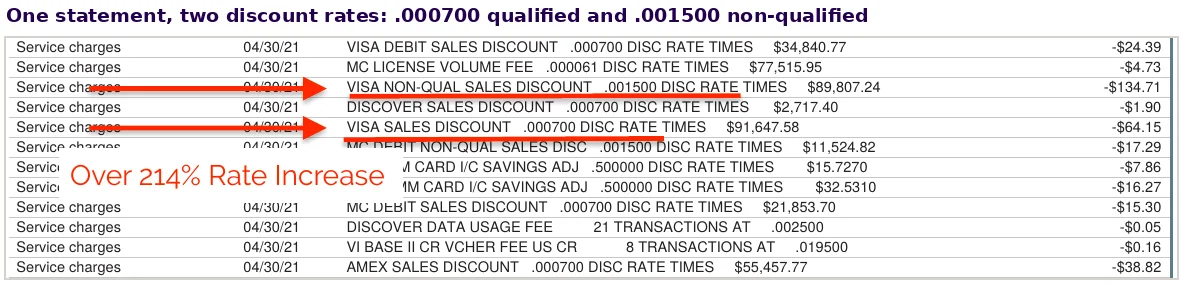
Note what a non-qualified discount rate is doing on a statement of this kind at all. Qualified and non-qualified tiers belong to tiered pricing, the model where the processor decides which bucket each transaction falls into. Finding that language on an account sold as pass-through is the tell. The buckets aren’t defined anywhere the merchant can see, so there is no arguing about which bucket a transaction belonged in.
The base rate itself moves
Eventually, the 0.07 percent stops being the rate. On the statement below, it becomes 0.36 percent, an increase of more than 400 percent, and the whole thing is visible inside one document if you know where to look.
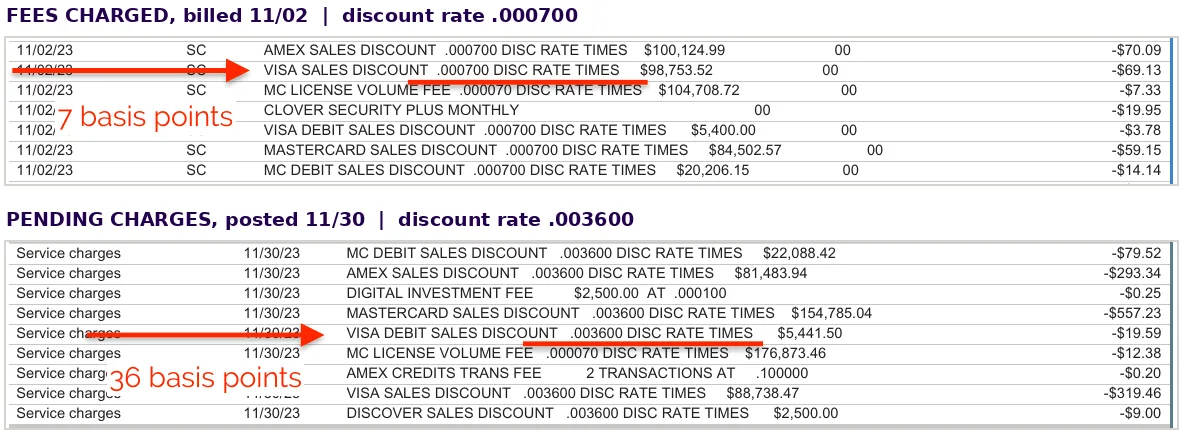
Almost nobody reads the Pending section. It sits after the totals; it is labeled as not yet funded, and it looks like housekeeping. It is where the increase lived for a full month before it ever showed up as money.
One detail makes the point beyond argument. In that same block, the MC LICENSE VOLUME FEE stays at .000070 in both sections, because it is a genuine Mastercard pass-through and Mastercard did not change it. Only the processor’s own discount rate moved. Whatever this was, it was not the card brands.
Additional cost per year to that merchant from the rate change alone, on roughly $355,000 a month in card volume. The discount rate dollars go from about $216 in the charged month to about $1,278 in the pending month.
And the number nobody thinks to question
Worth saying plainly, because it reframes the whole sequence: at this volume, 0.07 percent was already high. A merchant running several hundred thousand dollars a month should be nearer 3 basis points over true cost. So stage one, the rate that reads as a bargain and that every merchant in this sample was happy with, is already more than double where it should have been. The escalation starts from a number that was never the good news it appeared to be.
The clause where they take half your savings
One more line from the industrial supplier’s statement, because we get asked about it and it deserves naming:
- VI COMM CARD I/C SAVINGS ADJ .500000 DISC RATE TIMES
- MC COMM CARD I/C SAVINGS ADJ .500000 DISC RATE TIMES
When commercial card transactions are submitted with Level 2 or Level 3 data, interchange drops. That saving belongs to the merchant, since it is the merchant’s data and the merchant’s transaction. A rate of .500000 means the processor is billing back half of it. You save money and hand 50 percent of the savings straight back, in a line item most people read as an adjustment in their favor.
Three statements, three different amounts of truth
The rates above are only visible because those statements print their fee detail. Plenty do not. These three accounts all bill through Fiserv, which you can tell from the front page: the Fiserv logo, the Omaha remittance box, and the service address at commercecontrol.com, Fiserv’s own merchant portal, previously Business Track and before that ClientLine.
One number, and nothing else
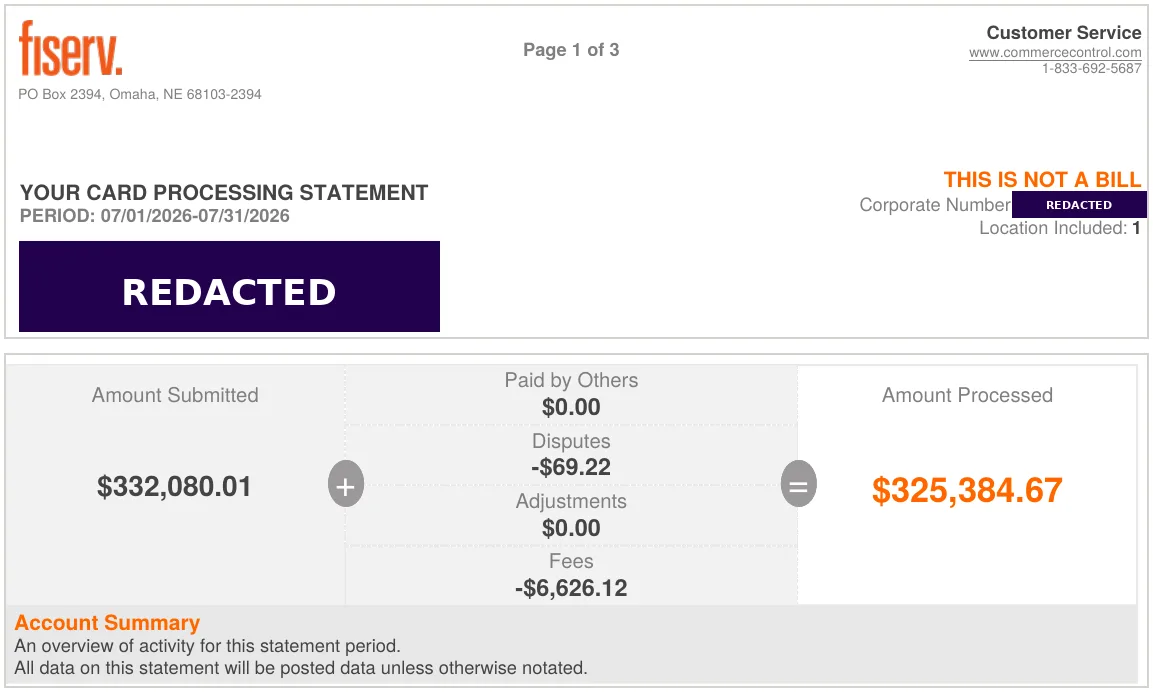
This merchant ran 332,080.01 and was charged 6,626.12, an effective rate of almost exactly 2.00 percent. There is no interchange section, no fee section, no discount rate, no per-item count, and no card mix. The daily table shows $0.00 in fees for all thirty-one days, then one row labeled Month End Charge for the whole amount.
Two percent sounds unremarkable, and that is the trap. This is a high-volume, low-ticket business with an average sale of $57.92, which means a large share of the card mix is debit, and regulated debit interchange is capped by law at roughly 0.05 percent plus 21 cents. A business like this has a much lower interchange floor than a card-not-present B2B account. Its effective rate should be low.
Estimated processor markup buried inside that 2.00 percent, depending on how much of the volume is regulated debit. Run the arithmetic at a 50, 60, and 70 percent debit mix against capped debit interchange and blended credit, and the residual lands in that band. Against a 3 basis point benchmark, it is not a close call.
That is an estimate, and we have labeled it as one, because the statement discloses no card mix at all, which is the point. Nobody, including this merchant, can turn that 2.00 percent into an answer. The number that would settle it was not printed.
Interchange in full, and a fee section that does not exist
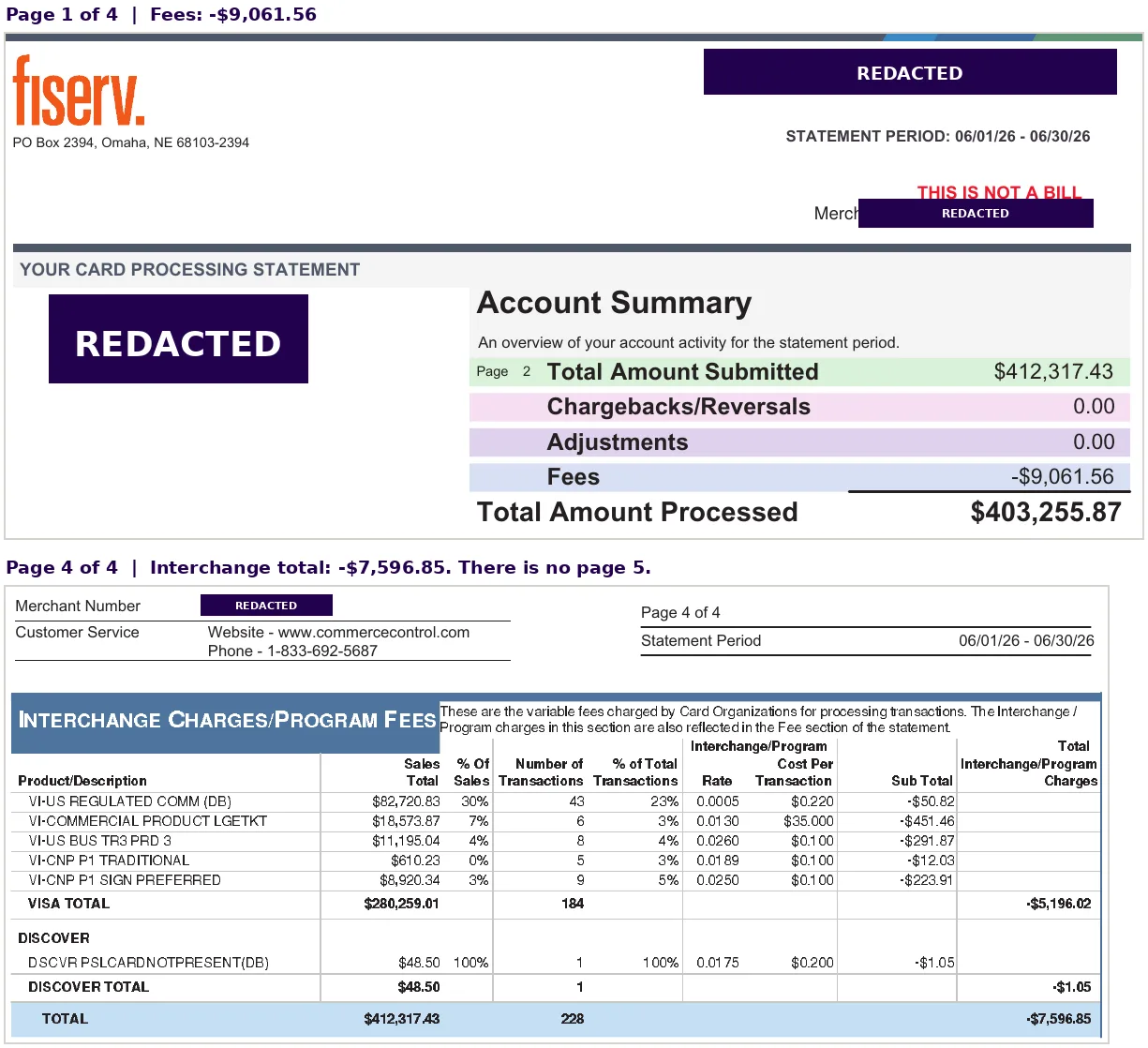
This one is more dangerous because it looks generous. A wall of interchange detail reads as transparency. But page one says total fees of 9,061.56 and page four says total interchange of 7,596.85. Between them sits $1,464.71 that is itemized nowhere: 16 percent of the bill, 35 basis points of volume.
Read the header on that interchange table. Fiserv’s own wording says those charges are also reflected in the Fee section of the statement. The statement is four pages long; page four is the last, and there is no Fee section.
Every line, including the markup
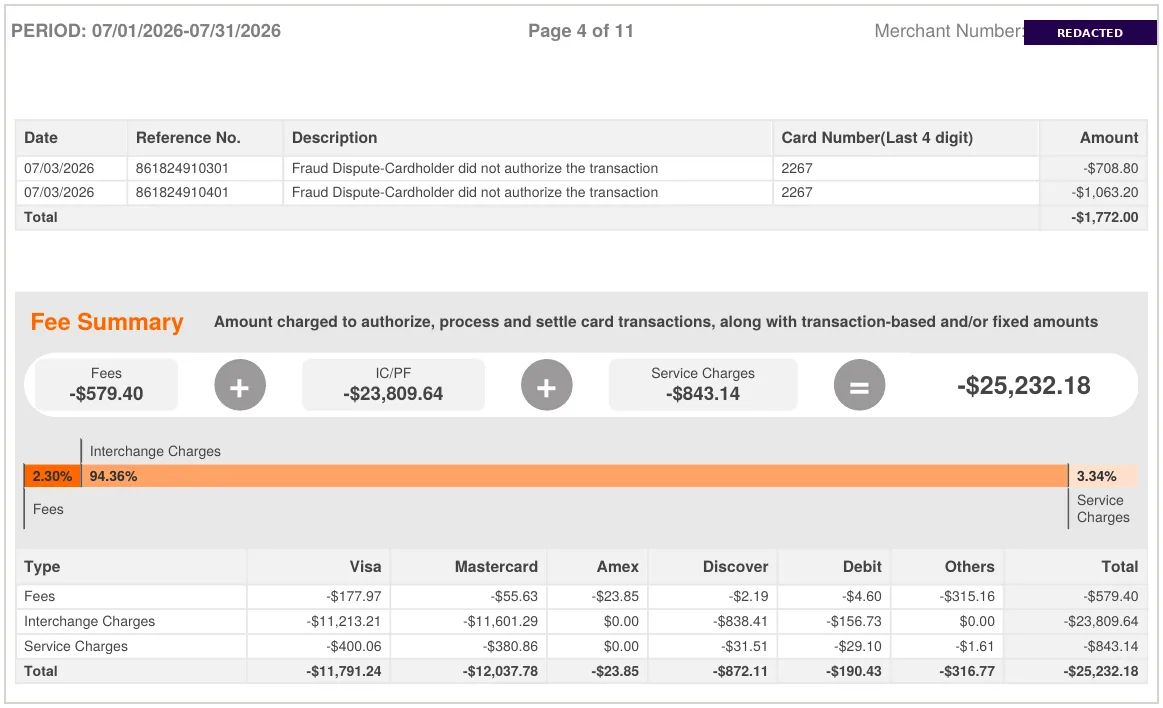
This is what a Fiserv statement looks like when nothing is hidden. 25,232.18 splits into 579.40 in fees, 23,809.64 in interchange and program fees, and 843.14 in service charges, with the 2.30 / 94.36 / 3.34 percentage bar underneath. Behind it run more than 160 itemized charge lines and an interchange table of more than 170 rows, and the processor’s own take is printed repeatedly at a stated rate, SALES DISCOUNT .000780 DISC RATE.
You may or may not think 7.8 basis points is fair. The point is that this merchant gets to argue.
| Family entertainment | Food distributor | Auto dealer group | |
|---|---|---|---|
| Card volume | 332,080.01 | 412,317.43 | $1,211,877.07 |
| Total charged | 6,626.12 | 9,061.56 | $25,232.18 |
| Effective rate | 2.00% | 2.20% | 2.08% |
| Card mix disclosed | No | Yes | Yes |
| Interchange categories shown | 0 | 24 | 170+ |
| Itemized fee lines shown | 1 | 0 | 160+ |
| Discount rate disclosed | No | No | Yes, 0.078% |
| Dollars you can trace | 0.00 | 7,596.85 | $25,232.18 |
| Dollars you cannot | 6,626.12 | 1,464.71 |
The effective rate row is the one to sit with. Those three numbers are within twenty basis points of each other, and they mean completely different things, because the businesses have completely different interchange floors and only two of the three tell you what theirs is. An effective rate without a card mix is not a measurement. It is a rumor.
Who turns the detail off
Statement format is not a law of physics. It is a setting, and somebody chose it.
In our experience, it is not usually the rep who boarded the account. It is whoever owns the relationship now. The relationship manager can change the format after the fact, often in the same window as a pricing change. That is not a coincidence. The two decisions serve the same purpose.
You cannot dispute what you do not see. It does not require a lie or a hidden clause. It requires a checkbox and a merchant far too busy running a business to hunt for a fee section that was never printed.
And we are seeing more of it, not less. The stripped statement used to be unusual. It is now arriving in our audit queue at a rate that has our attention, alongside the round of across-the-board increases pushed through over the last two years.
How to tell which statement you are holding
Has a Fee Summary or Fees section splitting the total into buckets before any detail.
Names a discount rate as its own line, with the rate and the volume it applied to.
Shows per-item fees with a transaction count and a unit rate.
Breaks volume down by card type, so you know your interchange floor.
Interchange plus fees reconcile to the total charged, to the penny.
Fees appear as one figure and never break down anywhere.
The daily table shows $0.00 fees every day, then one lump at month-end.
Interchange is itemized, but the totals do not reconcile.
A section header refers you to a section that is not in the document.
No card mix, so the effective rate cannot be interpreted.
Then do the two things the statement will not do for you. Divide total fees by total volume to get your effective rate. And read the Pending Financial Charges section every month, comparing its rates against the section above it. That is where the footwear merchant’s 400 percent increase was sitting in plain sight.
Seeing a fee you do not recognize? Before you call anyone, find out whether it is a real fee at all. Our Credit Card Processing Statement Decoder covers the line items one by one, what each one genuinely is, who actually sets it, and which ones are invented. A surprising number of official-sounding charges turn out to be neither Visa’s nor Mastercard’s.
Fiserv goes by a great many names
One reason merchants do not realize they are comparing two Fiserv accounts is that Fiserv rarely says Fiserv. The statement may carry a bank’s name, a reseller’s name, a product name, or a portal name.
| Name you might see | What it actually is |
|---|---|
| First Data | Acquired by Fiserv in 2019. The contracting entity on most US Fiserv merchant agreements is still First Data Merchant Services LLC. |
| CardConnect, CardPointe | Acquired by First Data in 2017, now a Fiserv subsidiary, still marketed under its own brand with its own sponsor banks. |
| Clover, Clover Connect | Fiserv’s point-of-sale platform and its integrated payments channel, both wholly owned. Priced by whoever sells it, which is why Clover fees vary so widely. |
| BluePay, Payeezy, TeleCheck, Money Network | All Fiserv owned. Payeezy is being migrated onto Fiserv’s Commerce Hub. |
| STAR, Accel, MoneyPass | Debit networks Fiserv owns and operates. |
| Commerce Control Center, Business Track, ClientLine | The same Fiserv merchant portal, renamed twice. If your statement points you to commercecontrol.com or businesstrack.com, you are on Fiserv. |
| Bank branded merchant services | Fiserv’s own bank contact directory lists roughly ninety US bank and credit union merchant brands routed to Fiserv support, including PNC Merchant Services, Santander, Huntington and SunTrust. |
Behind those brands sit the 3,000-plus ISO partners covered earlier, plus the software vendors and bank partners. Fiserv’s annual Form 10-K describes distributing through partnerships with hundreds of indirect non-bank sales forces, including independent sales agents, ISOs, software vendors, and payment services providers. It has also bought several ISOs outright, among them MerchantPro Express, Pineapple Payments and Merchant One.
Worth knowing that even Visa does not claim to have a full census of this population. When asked how many integrators and resellers operate in its ecosystem, Visa told Digital Transactions it could not provide a figure because it does not know the full population.
The practical consequence for you: two businesses on the same street, both on Fiserv, can pay completely different amounts under completely different fee names, because the reseller in the middle sets the markup and, increasingly, sets how much of it you get to see.
They will lower the fee. That is not the same as fixing it.
Here is the part that decides whether any of this actually costs you money over the long run.
Call your processor and complain about a fee, and there is a good chance it comes off. Sometimes on the first call. You will feel like you handled it, and the person who removed it will be pleasant about it, because you are not the first merchant to call and they are not surprised to hear from you. That is a well-practiced conversation on their end.
Then look at what happens next. This industry makes billions a year from merchants who all had that same satisfying phone call. Next month, or three months later, or after the April or October release, the money comes back, not under the same name. Sometimes under no name you can point at. Sometimes it is not a fee at all anymore, just interchange that has quietly been billed above the published rate.
They do not start playing fair because you asked them to. Some of our largest clients have fought this for years, watched their statements closely, and were still being overbilled by more than ten million dollars a year. Not for lack of attention. Because they were fighting an opponent that writes the rules, changes the fees twice a year, and holds every card.
That is the real asymmetry, and it is worth being honest about what it takes to close it. Visa and Mastercard revise interchange every April and October. Rates move, categories are added, qualification criteria shift. Auditing against that requires software that knows what every rate was supposed to be in every month, and that software has to be substantially rebuilt twice a year, every year, forever.
We have invested more than a million dollars in ours. It is our second largest expense after people, and it will keep being an expense for as long as we do this. Now ask the question the processors are counting on you not asking: even if a single merchant had the expertise in-house, would that investment ever make sense for one company’s statements?
It would not. And they know it. That imbalance is not a side effect of the business model. It is the business model.
Common questions
How much does Fiserv charge for credit card processing?
There is no single Fiserv rate. Pricing is set by whoever sold you the account, which may be Fiserv directly, a bank running on the Fiserv platform, or one of hundreds of independent resellers. In the statements examined here, the processor’s discount rate ranged from 0.07 percent to 0.36 percent, and two of the statements did not disclose it at all.
Why do two merchants on the same processor pay such different fees?
Because the processor is usually not the one who sets your price. Fiserv reports more than 3,000 independent sales organization partners, all reselling the same platform. Interchange, the largest part of the cost, follows a published schedule identical for all of them, so they cannot compete on service cost. They compete on the markup they add and on how visible that markup is. Two identical businesses can end up hundreds of basis points apart purely on who knocked on the door.
What is a non-qualified discount rate on my statement?
It is a second, higher discount rate applied to transactions the processor has decided did not qualify for your normal rate. In one statement here, the non-qualified rate was 0.15 percent against a qualified rate of 0.07 percent, more than double, with roughly 37 percent of discounted volume routed into it. The criteria aren’t published anywhere the merchant can check, which makes the arrangement difficult to dispute.
Why did my discount rate go up without notice?
Rate changes are commonly disclosed as a line in a statement message, and continuing to process is treated as acceptance. Check the Pending Financial Charges section against the Fees Charged section on the same statement. If the rates differ between the two, the increase has already occurred and will hit as a charge next month.
Why does my Fiserv statement not show interchange?
Because the statement format is configurable and someone selected a version that suppresses it. This isn’t a printing error or a platform limitation. Fiserv prints fully itemized statements for other merchants on the same system in the same month. If yours doesn’t show interchange, that decision was made about your account, and you can ask to change it.
Is a low effective rate proof of a good deal?
No. Your effective rate depends heavily on your card mix because regulated debit interchange is capped by law, while credit interchange is not. A debit-heavy business should have a low effective rate. Comparing your effective rate to another merchant’s without knowing both card mixes tells you nothing, and a statement that does not disclose card mix has removed your ability to interpret your own number.
My processor removed the fee I complained about. Am I fine now?
You are fine this month. Getting a single fee waived is the easiest thing to achieve in this industry, which is worth thinking about. What matters is whether the same money reappears later under a different name, in a different section, or inside interchange. That is a question about the next twelve statements, not this one.
What is commercecontrol.com on my statement?
It is Fiserv’s merchant reporting and dispute portal, previously branded Business Track and before that ClientLine. Seeing it means your account settles through Fiserv, regardless of whose name is at the top of the page.
Send us the statement. We will tell you what is in it.
Free, no obligation, and you can fire us at any time. If we find nothing, you pay nothing. We have been doing this since 2009, and we find savings on roughly 99 percent of the audits we run.
Get My Free Audit See How the Audit Works 800-672-1292More on Fiserv: the full Fiserv entry on the Processor Scoreboard covers the regulatory record, contract terms, and exit clauses. Related reading: How Can I Have The Lowest Discount Rate and The Worst Deal?, Interchange Fees, Merchant Statement Example, Overbillings, Savings Calculator.
Cite this page
How these figures were produced. Five Fiserv merchant statements supplied by the merchants themselves, redacted for client protection and reproduced without alteration to the figures. Effective rates are the total amount charged divided by total card volume for the same statement period. Where a statement discloses no card mix, any markup figure is presented as an estimate with its assumptions stated on the page.
Next review: October 2026, when Visa and Mastercard publish their autumn interchange revisions. Media and research inquiries: contact weAudit.
© 2009-2026 weAudit.com. All rights reserved. Fiserv, First Data, CardConnect, Clover, Business Track, ClientLine and Commerce Control Center are trademarks of Fiserv, Inc. or its subsidiaries. weAudit.com is not affiliated with, endorsed by, or sponsored by Fiserv, Inc. Statement images are redacted client documents reproduced for educational purposes.
This page is provided for general educational purposes and is not financial, legal, or accounting advice.

Want to talk?
- Call us today 800-672-1292
- Book a free consultation
As seen on