The decade no one wants is already arriving early.
Robert DayFounder and Managing Partner of weAudit.com. Over 35 years in financial services, including more than a decade as an executive at Fifth Third Processing Solutions, later Vantiv and Worldpay, now part of Global Payments, the world’s largest card processor. Forbes Business Council member and Entrepreneur contributor.Published August 14, 2026 · Reviewed against the 2026 Trustees Reports and CBO outlook
The 2030 great depression is not a headline. It is a forecast, and a specific one. ITR Economics, one of the oldest continuously operating economic research firms in the country, projects a depression beginning in the 2030s. Not a recession. A depression, running roughly six years. So far the unemployment line has not formed. The arithmetic has.
This page is not a prediction of doom. It is also not a sales pitch dressed as one. Instead, it is a plain reading of what the 2030 great depression forecast actually says. Which parts are forecast, which parts already sit on the federal calendar, and what an owner can reasonably do about it this quarter. So if you came here asking whether a depression is coming, the honest answer is more interesting than yes or no.
The 2030 great depression in five lines
The 2030 great depression is forecast, not observed. ITR Economics projects a depression beginning in the early 2030s and running roughly six years, with the trough around 2036.
The scariest numbers are not forecasts at all. Social Security’s retirement trust fund is projected to deplete in 2032 and Medicare’s hospital fund in 2033, each triggering automatic cuts under current law.
Today’s economy is calm, and that is the point. Announced job cuts are down 41% year over year and the layoff rate is historically low, which is precisely when preparation is cheapest.
A recession is something you ride out. A depression is something you restructure for. The difference is repeated failure to recover, not severity in a single quarter.
The first move is subtraction, not growth. Cut costs you should never have been paying, starting with the percentage based ones nobody reviews, then convert the savings into a reserve.
$39TU.S. national debt as of fiscal year 2026Peter G. Peterson Foundation
2032Year the Social Security retirement trust fund is projected to run dry, triggering an automatic 22% benefit cut2026 Trustees Report
120%Projected federal debt as a share of GDP by 2036, past the 1946 wartime record of 106%Congressional Budget Office
94.7%The lowest annual accuracy ITR Economics has recorded on its twelve month forecasts since the 1980sITR Economics
The Forecast
Is a depression coming? What the forecast actually says.
The short answer: a depression is forecast, not observed. ITR Economics projects one beginning in the early 2030s and lasting about six years. However, no current economic data shows a depression underway. Any page telling you otherwise is selling fear. So what makes the 2030 great depression forecast worth taking seriously is not the alarm. It is the set of federal obligations that come due inside the same window, whether or not the forecast turns out to be right.
Who forecasts the next great depression, and how good are they?
ITR Economics has been publishing economic forecasts since 1948. Each year the firm audits itself, comparing the forecast in place on January 1 against the actual year end result. Since the 1980s that audit has never returned a rate below 94.7%. So the track record is specific and auditable. But it is worth understanding precisely because of what it is not. A firm can be excellent at calling next year and still be making an argument rather than a measurement when it points ten years out.
Why the 2030s forecast says depression and not recession
What ITR projects for the 2030s is a depression rather than a recession. Moreover, the distinction is structural rather than emotional. Their definition requires three consecutive business cycles in which each low sits below the one before it. That is why the projected span runs roughly six years instead of the two to four quarters a normal recession takes. Recoveries do occur in between. They are simply not strong enough to reach the prior peak before the next decline starts.
In Their Words
“Action is imperative.”
ITR frames the 2030s as a once in a lifetime event that today’s business leaders have never personally experienced. Furthermore, it warns that the trends behind the coming depression carry so much momentum that they will be difficult to change. Their stated purpose in publishing the forecast is not fatalism. Rather, it is to get owners moving while acting is still cheap.
Source: ITR Economics, 2030s Great Depression
The Distinction
Recession vs depression: why the difference decides what you do.
The difference between a recession and a depression is not severity in a single quarter. Rather, it is whether the economy gets back to where it started. A recession typically runs two to four quarters, then recovers to the prior peak. In a depression, recovery repeatedly fails to do that. So each cycle starts from a lower floor than the one before it. That distinction is not academic. In fact, it is the entire reason the 2030 great depression calls for a different response than an ordinary slowdown does.
Recession
Depression
Typical length
Two to four quarters
Years. ITR projects roughly six for the 2030s
Defining feature
A decline followed by a recovery that regains the prior peak
Three consecutive cycles in which each low sits below the previous low
How often
Routine. The United States has had eleven since 1948
Rare. The last one began in 1929
Usual policy response
Deficit spending and monetary easing, deployed quickly
The same tools, but constrained by debt service and entitlement obligations
What it does to a business
Compresses demand temporarily. Survivable on the balance sheet you already have
Resets demand to a lower level for years. Survivable only on a cost structure built in advance
When preparation works
During the downturn is often good enough
Before it starts, or not at all
What the recession vs depression distinction means for your business
Here is the practical translation. In a recession you can usually cut discretionary spending, defer a hire, lean on a credit line, and wait. Those moves work because the clock is short and the recovery is real. In a depression the clock is not short. Cost cuts made in month four still have to hold in year four. Meanwhile banks pull credit lines rather than extend them. And a competitor who entered leaner than you can outlast you on nothing more than arithmetic. That is why useful preparation is structural rather than tactical. You are not trying to weather a quarter. Instead, you are trying to arrive with a permanently lower cost of doing business.
The Arithmetic
When is the next great depression, and why does the math point at 2030?
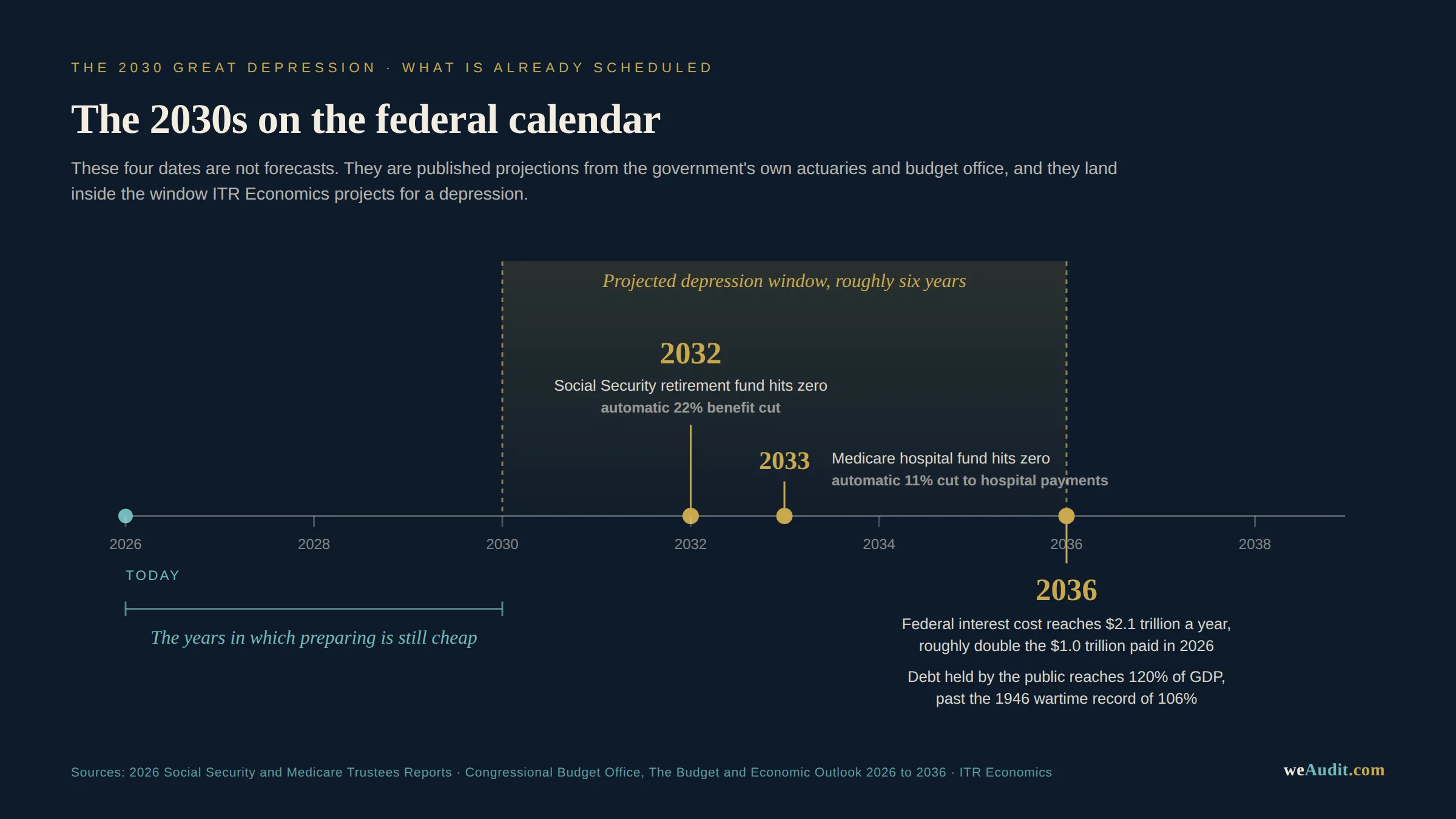
Here is the part that gets lost in the headlines. You do not have to accept anyone’s ten year forecast to take the 2030s seriously. Because the most uncomfortable numbers behind the 2030 great depression argument are not forecasts at all. They are published federal projections with dates attached, produced by the government’s own actuaries and the Congressional Budget Office. Reasonable people argue about what those numbers will cause. Almost nobody argues about whether they sit on the calendar.
2032Social Security
Social Security’s retirement trust fund hits zero, on the Trustees’ own projection. Under current law, depletion is not a debate. It triggers an automatic benefit reduction of roughly 22%, and it hits every retiree at once. Furthermore, the 2026 Trustees Report moved the date closer and raised the seventy five year shortfall by about 16% in a single year. That tells you the direction of travel.
2033Medicare
Medicare’s Hospital Insurance trust fund reaches the same point. That triggers an automatic cut of roughly 11% to hospital payments, growing over time. So two of the largest transfer programs in the federal budget hit their statutory wall within twelve months of each other. And they do it inside the exact window the 2030s depression forecast covers.
2036Interest
Annual interest on the national debt roughly doubles, from about $1.0 trillion in 2026 to $2.1 trillion. By then interest alone consumes close to one fifth of all federal spending. Interest already ranks as the second largest line in the federal budget, behind only Social Security.
2036Debt to GDP
Federal debt held by the public reaches 120% of GDP, passing the 1946 record of 106% that the country set financing a world war. Over the same span the annual deficit grows from $1.9 trillion to $3.1 trillion.
The four dates behind the 2030 great depression argument, and the years still left to prepare. Sources: 2026 Social Security and Medicare Trustees Reports, Congressional Budget Office, ITR Economics.
Why the usual rescue may not arrive on time
Put those four together and you get the mechanism ITR is actually describing. Washington met every previous downturn in living memory the same way. It spent into the decline while the Federal Reserve eased into it. However, the 2030s are the first stretch in which the country arrives at a downturn already carrying three burdens at once. Entitlement obligations rise sharply. Interest costs crowd the budget. And a demographic shift means the number of people drawing benefits grows faster than the number funding them. So the concern behind the 2030 great depression forecast is not that a recession happens. Recessions always happen. The concern is that the usual response now costs far more than it ever has. As a result, help may arrive smaller and later than owners have been trained to expect.
The Honest Part
Are we headed for a depression right now? The economy is calm, and that is the argument.
No. Not right now, and not on any current reading of the data. We would rather tell you that than sell you a panic. A lot of content on this topic opens by claiming the sky is falling this month. We are not going to, because as of the summer of 2026 it plainly is not. And you can check the numbers yourself.
Challenger, Gray & Christmas counted 477,033 announced job cuts through the first seven months of 2026. That is down 41% from the 806,383 announced over the same period in 2025. Meanwhile announced hiring plans rose about 25% year over year. The Bureau of Labor Statistics puts the monthly layoff and discharge rate at 1.1%, which is historically low. Roughly 1.8 million Americans lose a job in a typical month even in a strong economy, because a labor market of 160 million people churns constantly. So that number sounds alarming when quoted alone. It is not.
So if you are scanning this page for evidence that the depression has already started, you will not find it here. What you will find is the reason that matters more.
Why preparing for a depression works best before one starts
Every preparation worth making is available to you right now, at a discount, precisely because nothing is wrong yet.
Cutting waste is easy while you are profitable and nobody is panicking. Renegotiating a vendor is easy while you are not desperate. Building a reserve is possible while revenue holds steady. Auditing your cost structure takes management attention, and management attention is abundant in calm quarters and nonexistent in bad ones. Therefore owners who wait for a headline act at the exact moment every one of those advantages is gone. And every counterparty on the other side of the table knows it.
There is a second reason the calm matters. Even if the 2030 great depression forecast turns out to be wrong, and it may be, everything on the list below still leaves you with a leaner, better documented, more profitable business. That is an unusual quality in preparation. Most contingency planning is a pure cost you hope to waste. This one is not.
The Playbook
How to prepare your business for the 2030 depression
Five moves, in the order we would make them. Notably, none of them require you to believe any particular forecast. Instead, they are what survivors of every previous downturn did before the downturn arrived. All five sit on one idea: in a contracting economy, a dollar you protect inside the business is worth more than a dollar you chase outside of it.
This is also, in plainer language, how to recession proof a business. There is no separate playbook for surviving a recession and surviving a depression. There is one playbook. And the only variable is how much of it you finished before the downturn started.
01
Find the money you are already losing before you go looking for new money.
Audit, then audit again. Most owners skip this because they assume they already know where the money goes. But expertise in your own business does not make you a tax expert, a utility expert, a freight expert, or a specialist in credit card processing statements. Those are separate trades. Meanwhile the vendors on the other side of each one employ people who do nothing else all day.
Start with the categories billed as percentages rather than fixed amounts. Those grow silently with your revenue and never come up for review. Merchant processing is the clearest example, and usually the largest.
Card processing fees are frequently the second highest cost of doing business, behind payroll.
And most companies have never had them audited. Most do not know that credit card processing is an unregulated industry, with no agency reviewing what shows up on the statement. Furthermore, almost none have sat with what it means that their processor holds unchecked access to their bank account, and withdraws whatever it has decided it is owed before a single human being on your side reviews the number.
What processors did the last time businesses were hurting
If you want evidence for what a downturn does to your statement, you already have it. During COVID, when businesses were hurting, the processors felt that same loss. So that is exactly when we saw the biggest uptick of the modern era in junk fees quietly appearing on statements, alongside existing fees being inflated. Businesses that were already struggling paid more for the privilege of struggling.
Will that repeat? Will merchants put the proper stops in place before it does, rather than after? Will they get audited now, while the savings still have time to become a reserve?
Nobody can force the answer. But note which direction the incentive runs. In a contracting economy your processor sits under exactly the same margin pressure you do. Moreover, it is the only vendor in your business that can answer that pressure by helping itself directly from your account. The stop is simple, and it is available today, years before any depression arrives. Know your true effective rate, know what every line item is, and have the statement audited before the pressure arrives rather than after it has been quietly billed to you.
02
Build the cash reserve now, while credit is still available and cheap.
Everyone agrees a reserve is essential. However, the harder question is where the money comes from. Sell more? Raise prices into a price sensitive market? Squeeze suppliers you will need later? Or simply stop paying for things you should never have been paying for.
The fourth option is the only one with no downside and no counterparty to upset. It also compounds. A recovered overcharge is not a one time win. It is a recurring monthly cost gone from the business permanently, which is exactly the kind of durable saving a depression rewards.
Recovered overbilling is the rare source of cash that costs you nothing to raise and nobody to negotiate with.
03
Reduce your dependence on expensive debt before the terms change.
Debt is a tool right up until credit tightens. After that, in a recession or a depression alike, it becomes the thing that decides whether you survive. Even healthy companies get into trouble when borrowing funds ordinary operations rather than genuine expansion. And if federal interest costs really do climb toward $2.1 trillion a year, private borrowers do not get to sit that out.
Every recurring expense you eliminate now does double duty. First, it improves the coverage ratios a lender looks at. Second, it frees cash to pay down principal faster, while refinancing is still an option rather than a hope.
04
Insist on financial transparency from every vendor with access to your bank account.
Long before any depression arrives, you should be able to validate every fee you pay and verify every debit against your operating account. No vendor with direct access to that account should ever remove funds without a clear explanation and documentation behind it. So if you cannot reconstruct a charge from the statement alone, that is not a small problem. That is the problem.
This matters more in payments than almost anywhere else, because the credit card processing industry is unregulated. No agency reviews what appears on your monthly statement. There is no standard format. And nothing requires a line item to be named after what it actually is.
Processing statements are one of the few bills in American business that no regulator reviews and no standard governs.
05
Position to buy, not just to survive.
A 2030s depression would not destroy wealth so much as move it. Downturns generally do. Companies that go in with clean cost structures and cash on hand buy competitors. They hire talent that was unavailable at any price during the boom. And they take share from businesses that spent the good years assuming the good years were the baseline.
Writers reach for the 1929 comparison as a scare tactic. However, the more useful lesson from it runs the other way. Plenty of companies came out of the 1930s larger than they went in. Almost none of them started preparing in 1930.
In 1929 not everyone lost. Some of the strongest franchises in the country were assembled from businesses that had not planned.
One More Honest Thing
We only do one of these.
Card processing is the one we know cold, and it’s unregulated, no agency reviews it and no standard governs it. It isn’t the only category worth that kind of scrutiny. Insurance, freight, telecom, software subscriptions, bank fees, and vendor contracts all deserve it too, and we don’t audit those ourselves. If it isn’t us, find someone who specializes in that category specifically. Most of them will want a share of what they find rather than a flat fee, that’s a different model than ours, but a percentage of real savings still beats never having looked.
A Note to the Owner Reading This
The fastest cost to cut is the one you have never checked. That is exactly why it is still there.
Most business owners have never had an independent audit of their merchant processing. Not because they are careless, but because the statements look fine by design.
Every month the processor sends a clean looking statement. The fees come out automatically. Nothing jumps off the page. So because nothing looks wrong, nobody questions the charges. That is by design. The people who write those statements are very good at making sure you never have a reason to read them closely.
Looks fine and is fine are two different things. The overbilling lives in line items written to be skimmed past, in rates that drifted upward a few basis points at a time, in fees invented for services you never receive. You cannot recover what you have never been shown. And right now, nobody has shown you. So if you want to see this on a real statement first, our merchant statement example walks through an actual five page statement with $80,785.60 hidden inside it, and our statement decoder explains the line items one at a time.
In a strong economy, that overbilling is an expensive habit. In a 2030 great depression, it becomes a liability. Every dollar quietly leaving your account through a processor is a dollar missing from your reserve when the next decade tests it. And unlike almost every other cost cut available to you, removing it costs no one their job.
See what your statements are hiding.
A full audit. No cost. No obligation. Built for the 2030s.
We go through your current merchant processing statements line by line, flag every fee that does not belong, and show you in plain numbers what you are losing month over month. If there is nothing to recover, you will be the first to know, and you will have spent about five minutes finding out. But if there is, you will hold the documentation you need to act. Furthermore, our attorneys can pursue what you have already overpaid.
Request Your Free AuditNo commitment · No software to install · No interruption to your operationsCommon Questions
Frequently asked questions about the 2030 great depression
Is a depression coming?
No forecaster can tell you that with certainty, and anyone who claims otherwise is selling something. What can be said accurately is this: ITR Economics, a forecasting firm operating since 1948 with a documented floor of 94.7% accuracy on its twelve month forecasts, projects a depression in the 2030s lasting roughly six years. Separately, and independent of any forecast, the Congressional Budget Office and the Social Security and Medicare Trustees project specific fiscal breaking points inside that same window. The forecast is contestable. The dates are not.
When is the next great depression predicted to start?
ITR Economics places the onset in the early 2030s, with the trough around 2036 and a total span of roughly six years. Their definition requires three consecutive business cycles in which each low falls below the previous one, so the start date is better understood as the beginning of a sequence than as a single event on a single day. There will be recoveries inside it. They are projected to be too weak to regain the prior peak.
Why will there be a depression in 2030 specifically?
The argument rests on four things converging in the same decade. The Social Security retirement trust fund is projected to deplete in 2032 and Medicare’s Hospital Insurance fund in 2033, each triggering automatic cuts under current law. Annual interest on the federal debt is projected to roughly double to $2.1 trillion by 2036. Federal debt held by the public is projected to reach 120% of GDP by 2036, past the wartime record of 106% set in 1946. And global demographics shift decisively toward more beneficiaries and fewer contributors. The consequence is not that a downturn occurs, but that the usual remedy, deficit spending plus monetary easing, becomes far harder to deploy at the moment it is needed most.
Are we headed for a depression?
Not on any current reading of the data. Announced job cuts through July 2026 are down 41% year over year, hiring announcements are up about 25%, and the monthly layoff rate is historically low. The case for the 2030s rests on structural fiscal arithmetic rather than on present conditions, which is a slower and less dramatic argument but a considerably more durable one. Anyone pointing at this month’s numbers to claim a depression has started is misreading them.
How long is the 2030 depression forecast to last?
Roughly six years, with a trough around 2036. ITR arrives at that span from its definition rather than from a guess: a depression requires three consecutive business cycles in which each low falls below the previous one. Three cycles at typical length is about six years. Recoveries happen inside that window. They are projected to be too weak to regain the prior peak, which is what separates the pattern from a series of ordinary recessions.
Is ITR Economics credible?
ITR has been publishing forecasts since 1948 and states that its annual audit, comparing the forecast in place on January 1 against the actual year end result, has never returned accuracy below 94.7% since the 1980s. That is a specific claim about twelve month forecasts, and it is the right claim to weigh. A ten year projection is a different kind of statement, closer to an argument about structural forces than a measurement. Treat the near term record as strong evidence of rigor and the long range call as a well reasoned thesis rather than a settled fact. The federal projections cited on this page do not depend on ITR being right.
What is the difference between a recession and a depression?
A recession is a decline in economic activity that typically runs two to four quarters and is followed by a recovery that regains the prior peak. A depression is longer, deeper, and defined by repeated failure to recover. ITR uses three consecutive cycles with successively lower lows, which is why their projection spans about six years rather than a few quarters. In practical terms for an owner, a recession is something you ride out on your balance sheet. A depression is something you have to have restructured for in advance.
How do I prepare my business for the 2030 depression?
In order. First, eliminate costs you are already paying that you should not be. Second, convert those savings into a cash reserve. Third, reduce your reliance on debt while refinancing is still available. Fourth, insist on documentation for every debit against your operating account. Finally, position yourself to acquire rather than merely to survive. Start with percentage based costs such as card processing, because they scale silently with revenue and are almost never reviewed. Every one of these leaves you better off even if the forecast never comes true.
Are layoffs already signaling a depression in 2026?
No, and we would rather say so than sell you a panic. Announced job cuts through July 2026 totaled 477,033, down 41% from the same period in 2025, while announced hiring plans rose about 25%. The monthly layoff and discharge rate reported by the Bureau of Labor Statistics sits near 1.1%, historically low. Roughly 1.8 million Americans are laid off in a normal month regardless of conditions, so that figure quoted without context proves nothing. The case for preparing rests on structural fiscal arithmetic, not on the current jobs report.
What actually makes a business recession proof?
Not the industry it is in. Businesses that come through a recession or a 2030s depression intact tend to share four traits. First, a cost structure with no unexamined line items. Second, a cash reserve that is not a credit line. Third, low dependence on debt for ordinary operations. Finally, revenue that is not concentrated in one client or one channel. Notice that three of the four are subtraction rather than growth, which is why recession proofing is mostly unglamorous work done in good quarters. A business that waits until demand falls to start the work is not recession proofing. It is triage.
How much can a business actually recover by auditing its processing costs?
It varies with volume, industry, and how long the current agreement has been in place. That is precisely why the audit is free and the findings come before any decision. What is consistent is where the money hides: interchange downgrades, padded markups, invented monthly fees, PCI penalties assessed to companies that were already compliant, and rate increases applied without notice. Beyond stopping those going forward, past overbilling can often be recovered. You can see the full process on our credit card processing audit page, or read how recovery works on our fee refund and recovery page.
The Bottom Line
History favors the ones who did the boring work early.
You do not have to believe in the 2030 great depression to act as if the 2030s will be harder than the 2020s. Indeed, the federal calendar makes that case without any help from a forecaster. So strengthen your cash flow, your visibility, and your reserves while the doing of it is still optional. Because the businesses that come out of the next decade larger will be the ones that cleaned up their cost structure when no emergency forced them to.
Protecting Profits.Preserving Jobs.Preparing for Tomorrow.
Sources: ITR Economics (2030s Great Depression forecast and stated forecast accuracy methodology); Congressional Budget Office, The Budget and Economic Outlook 2026 to 2036; 2026 Social Security and Medicare Trustees Reports; Committee for a Responsible Federal Budget; Peter G. Peterson Foundation; U.S. Bureau of Labor Statistics, Job Openings and Labor Turnover Survey, June 2026; Challenger, Gray & Christmas Job Cut Announcement Report, July 2026. Figures current as of August 2026. This page is general business information and is not investment, tax, or legal advice.