


Chat with us, powered by LiveChat

Surcharge vs. Convenience Fee: What’s the Difference (and Which Can You Legally Use)?

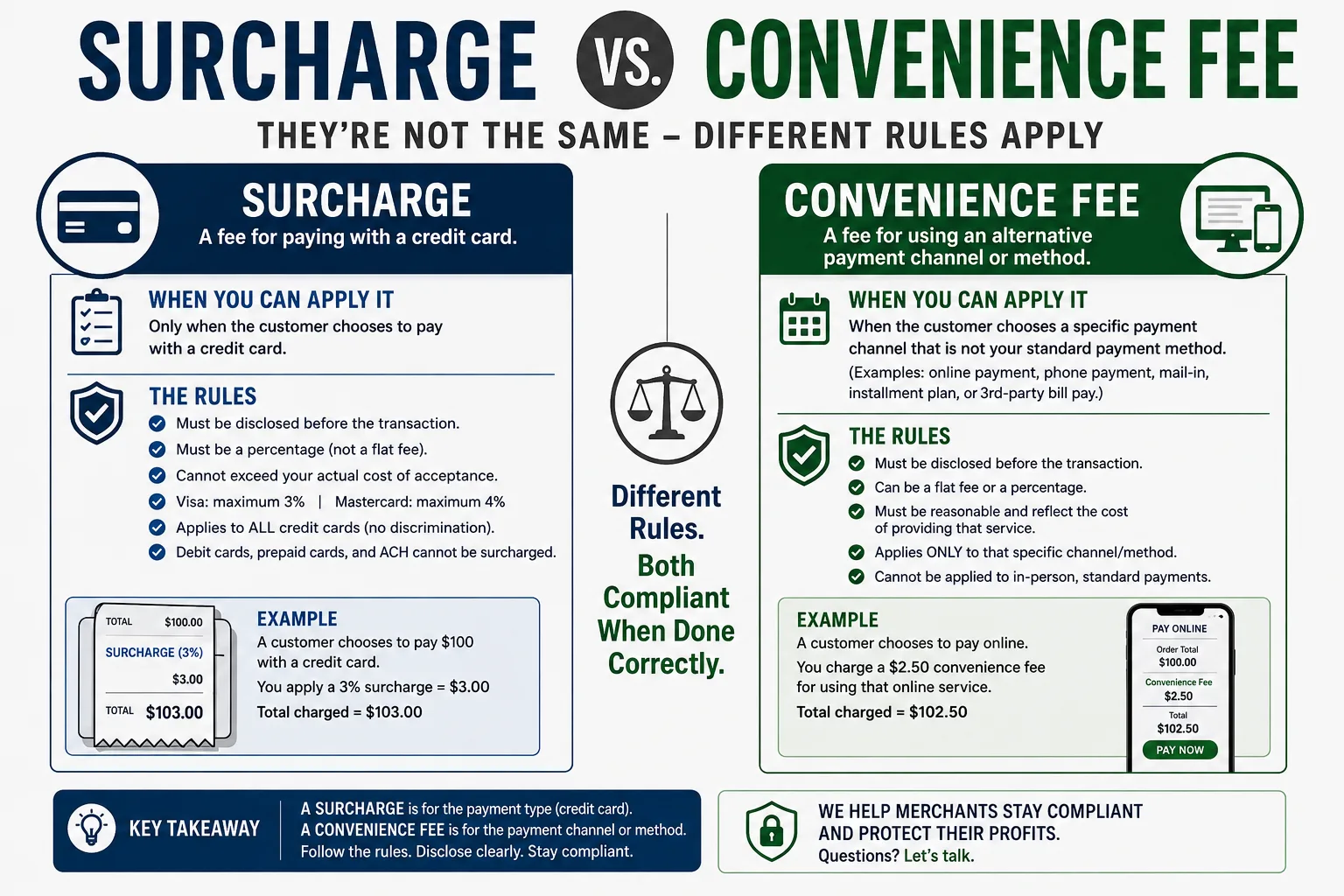
In this industry, the words “surcharge” and “convenience fee” get used interchangeably. They should not be. They are two different tools, governed by two different sets of rules, and most merchants who get fined for one thought they were doing the other.

There is also a third thing almost nobody mentions, a service fee, which is the only one of the three that lets certain merchants charge a percentage. If you qualify for it and do not know it exists, you are leaving the easiest option on the table.

Here is the difference, in the detail your processor’s sales rep probably skipped.

The one sentence version: a surcharge prices the card. A convenience fee prices the channel.

A surcharge says you paid with a credit card, so it costs more. A convenience fee says you paid through a channel we do not normally use, like our website instead of walking in, so it costs more. That distinction decides every rule that follows.

Surcharge vs. convenience fee, side by side

What you are charging for
Surcharge: the customer’s choice to use a credit card.
Convenience fee: the customer’s choice to pay through a channel outside your normal one.
Flat amount or percentage
Surcharge: a percentage, capped at 3% for Visa and 4% for Mastercard, and never above your actual cost of acceptance.
Convenience fee: a flat dollar amount only. $2.95, $4.00, $10.00. A percentage is not a convenience fee, no matter what your paperwork calls it.
Credit and debit
Surcharge: credit cards only. Surcharging debit is prohibited nationwide, with no exceptions.
Convenience fee: applies to every form of payment accepted in that channel, including debit. It is not a card fee, it is a channel fee, so it cannot single out cards.
In person
Surcharge: permitted in person, where state law allows.
Convenience fee: never in a face-to-face environment. If the customer is standing in front of you, there is no alternate channel being provided.
Advance notice to the networks
Surcharge: at least 30 days written notice to your acquirer before the first transaction.
Convenience fee: generally no network notification required, which is one reason it looks easier than it is.
Recurring payments
Surcharge: permitted on qualifying credit transactions.
Convenience fee: not allowed on recurring or installment payments. It was built for one-time payments.
Can you do both
No. You cannot charge a convenience fee and a surcharge on the same transaction. Pick one.

The full convenience fee rulebook

Visa’s requirements live in the Core Rules. Every one of these has to be true at the same time, and merchants usually fail on the second or the third.

All of these, all at once

1. It must be a genuine alternate channel. Online or by phone, when your normal channel is in person or by mail. The classic example is a theater that sells tickets at the box office and also lets you buy online for a couple of dollars more.

2. You must offer a standard channel with no fee. This is the one that disqualifies the most merchants. If you are online only, you have no alternate channel, because online is your channel. An e-commerce business cannot charge a convenience fee for using its own website.

3. Flat dollar amount, regardless of ticket size. The same fee on a $40 payment and a $4,000 payment. The moment it scales with the transaction, it is a surcharge and every surcharge rule applies to you retroactively.

4. It applies to every payment type in that channel. Cards, debit, whatever else you take there. You cannot apply it only to credit cards, because that makes it a card fee.

5. Disclose it before payment, with a chance to back out. The customer has to see it and be able to cancel before completing the transaction.

6. Include it in the transaction total. One authorization for the full amount. Not a second, separate charge.

7. One-time payments only. No recurring billing, no installments.

8. Charged by the merchant actually providing the goods or services. Not a third party layered on top.

The single most common violation we find: a merchant charging a percentage and calling it a convenience fee.

The label on your invoice does not decide what something is. The structure does. Charge 3% and call it a convenience fee, and you have an unregistered, undisclosed, unnotified surcharge, which is a considerably more expensive problem than the one you thought you had.

The third option: service fees

Here is what gets left out of nearly every article comparing these two, and it matters enormously if you happen to qualify.

A service fee is a modified convenience fee program available to specific merchant categories, and its defining feature is that it can be a percentage. Under Visa’s program it is limited to government agencies, educational institutions, and, following Visa’s October 2025 expansion, utilities. The merchant or its third-party provider must be registered with Visa and assigned a unique Merchant Verification Value. Mastercard has run its own Government and Education program since 2008, and does not require registration for it.

You have almost certainly paid one. When you pay federal taxes by card, the authorized payment processors charge a percentage-based fee, currently in the range of 1.82% to 1.99%. That is a service fee, not a convenience fee, and it is legal precisely because of the category the merchant falls into.

Who this actually applies to
Municipalities, courts, tax collectors, schools, colleges, universities, and now utilities. If you run a restaurant, a wholesaler, a medical practice, or a manufacturer, this program is not open to you, and any salesperson telling you otherwise is describing a violation. If you are in one of those categories and you are currently absorbing full card costs, this is worth a serious look, because it is the only sanctioned path to a percentage-based fee outside of surcharging.

So which one can you actually use?

Work down this list. The first one that fits is your answer.

Government, education, or utility?
The service fee programs are built for you, and they are the only route to a percentage that does not carry surcharge registration. Start there.
Do you have a real standard channel plus an alternate one?
A storefront or a mail-in process, plus an online or phone option. A convenience fee may fit, as a flat dollar amount, on one-time payments only. If you are online only, skip this.
Neither of those, and you still want to recover card costs?
Then you are talking about a surcharge, with everything that comes with it: state law, the 3% and cost-of-acceptance caps, the 30-day notice, disclosure at entry and at the register, and no debit ever.
Before any of the above
Find out what card acceptance is genuinely costing you. Your true cost is the legal ceiling on a surcharge, and for a lot of merchants it turns out to be considerably lower than they assumed once the inflated and invented fees come off the statement. It is hard to know what to pass along before you know what is real.

Thinking about surcharging specifically?

This page covers the difference between the fee types. The surcharging decision itself is a much longer conversation: which states ban it, what the fines run, why not one of the 500 largest companies in America does it, and the indemnity clause that leaves you holding the bill when the advice turns out to be wrong.

Read the full surcharging guide

Frequently asked questions

What is the difference between a surcharge and a convenience fee?

A surcharge is a percentage added because the customer paid with a credit card. A convenience fee is a flat dollar amount added because the customer paid through a channel you do not normally use, such as your website when you normally take payment in person. A surcharge applies to credit only and requires 30 days notice to your acquirer. A convenience fee applies to every payment type in that channel and generally requires no network notification.

Can a convenience fee be a percentage?

Under Visa’s rules, no. It must be a flat dollar amount regardless of the size of the payment. If you are charging a percentage, you are running a surcharge, and you are subject to every surcharge rule including registration, caps, and state law. The exception is the service fee programs available to government, education, and utility merchants, where a percentage is permitted.

Can I charge a convenience fee on a debit card?

Yes, and in fact you generally must, because the fee has to apply to all payment types accepted in that channel. This is the opposite of a surcharge, which may never be applied to debit under any circumstances. Just be careful that the convenience fee is not being used as a way to charge debit customers more at the point of sale, which is not permitted.

Can an online-only business charge a convenience fee?

No. A convenience fee compensates for an alternate channel, and if online is your only channel then there is no alternative and no convenience being provided. Merchants in this position who want to recover card costs are looking at a surcharge instead, with all of its requirements.

Can I charge both a convenience fee and a surcharge?

No. The card brand rules prohibit assessing both on the same transaction. You choose one model and apply it consistently.

Do convenience fees have to be disclosed?

Yes, before the customer completes the payment, and they must be able to cancel. State consumer protection law adds to this. California’s SB 478, effective July 2024, targets mandatory fees added late in checkout. Convenience fees are generally treated as optional because the customer can use the standard channel to avoid them, but a fee that appears only on the final screen is exactly the pattern that law was written to stop.

What is a service fee, and do I qualify?

A service fee is a special convenience fee program for government agencies, educational institutions, and, since Visa’s October 2025 expansion, utilities. It permits a percentage-based fee, unlike a standard convenience fee. Visa requires registration and a unique Merchant Verification Value. If your business is not in one of those categories, you do not qualify, and no processor can enroll you.

What happens if I call a percentage fee a convenience fee?

The networks look at the structure, not the label. A percentage-based fee is a surcharge, so you would be treated as a merchant surcharging without registration, without the required 30-day notice, and potentially in a state that restricts it. Visa’s non-compliance schedule begins at an immediate $1,000 assessment and escalates from there. Check your terminal and gateway configuration rather than assuming, because in our experience this is usually set up by someone else and discovered by the merchant much later.

The part they leave off the brochure
Your processor has a score. Do you know it?

If someone set up a fee program on your account, it is worth knowing their record. The Processor Scoreboard rates more than two dozen major processors from 0 to 100 on the documented record, sorted worst first, with the evidence behind every point deducted. No processor pays to be listed, and none can pay to be removed.

See Your Processor’s Score

Find out what accepting cards actually costs you

Send us your most recent processing statement. We will show you your true cost of acceptance, whether any fee program on your account is set up correctly, and what we can recover. It is free, and it takes about five minutes of your time.

Get My Free Audit

Or call us at 800-672-1292

A necessary note. This article is general information, not legal advice, and I am not an attorney. Card network rules are updated on their own schedule and state consumer protection law varies. Confirm your position with counsel licensed in your state and with your acquirer before implementing any fee program. Rules described here are current as of August 2026 and are drawn from Visa’s published Core Rules guidance and card brand program documentation.

Read More

Check out our other insights here

Warning If You Use Bank of America For Credit Card Processing

View

Do You Have Risk Fees On Your Credit Card Processing Statement?

View

Want to talk?

As seen on