


Chat with us, powered by LiveChat

PCI Non-Compliance Fee? You May Not Owe It |

Non PCI Compliance Fee

A PCI non-compliance fee is often a penalty you do not actually owe

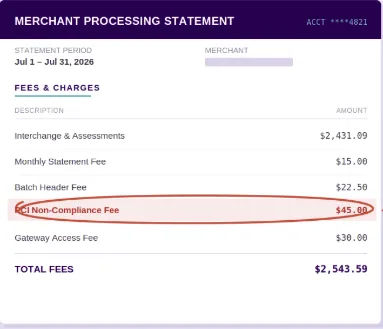
If a recurring PCI non-compliance fee showed up on your statement, your first assumption is probably that you did something wrong. Usually you did not. In a non-regulated industry, this fee is one of the easiest charges for a processor to apply and one of the hardest for a merchant to question. Many businesses paying it every month are either already compliant or were never given a real way to become compliant.

Here is what the fee actually is, how to tell when yours is an unjustified penalty, how to stop it, and how to recover what you have already paid.

What a PCI non-compliance fee actually is

PCI DSS is the security standard every business that accepts cards is expected to meet. Validating compliance is usually a matter of completing a self-assessment questionnaire and, depending on your setup, a scan. A PCI non-compliance fee is what a processor charges when its records show you have not validated. On paper it is meant to be an incentive to get compliant.

In practice it often becomes a quiet monthly penalty. The processor collects it whether or not you were ever told what to do, whether or not you already validated somewhere else, and in some cases even after you completed the steps. Because it sounds official and technical, most owners assume it is legitimate and simply pay it.

When your PCI fee is a red flag

Not every PCI charge is wrong. Some processors charge a flat PCI program fee that is disclosed and legitimate. The problem is the non-compliance penalty applied to merchants who should not be paying it. Yours is worth challenging if any of these are true:

  • You were never given a path. No one sent you the questionnaire, no portal, no instructions, just the fee.
  • You already validated. You completed an SAQ or scan and the fee kept coming anyway.
  • It appeared with no notice. The charge showed up on a statement without a clear explanation or a clear way to make it stop.
  • It is a flat monthly amount that never changes. A penalty that runs on autopilot for a year or more, regardless of what you do, is functioning as revenue, not as an incentive.
A PCI non-compliance fee is frequently small enough to ignore and persistent enough to add up. At $20 to $50 a month, a fee you never owed quietly becomes hundreds of dollars a year, and it is exactly the kind of charge an audit is built to find and reverse.

How to stop the fee: Easy PCI

The reason so many merchants stay non-compliant on paper is that the process feels intimidating and no one walks them through it. It does not have to. With weAudit’s Easy PCI handholding, about 90 percent of clients are certified in under an hour. Once you are validated, the basis for the non-compliance fee is gone, and it stops.

Left alone
The fee keeps coming, the compliance box stays unchecked, and you are also carrying real security exposure you were never helped to close.
With Easy PCI
You are walked through validation in about an hour, the non-compliance basis disappears, and the recurring penalty stops going out of your account.

Recovering PCI fees you never owed

Stopping the fee going forward is only half of it. If you were charged a non-compliance penalty you did not owe, whether because you were never given a path or because you had already validated, that money can be pursued. weAudit documents the charge, and because we are partly owned by an attorney and work with a nationwide network of them, we can pursue recovery of what you already paid. A PCI penalty is often just one line on a statement carrying other overcharges, which is why it is worth looking at the whole picture. Our fee refund and recovery service explains how that works.

Why weAudit and not your processor

Your processor is the one collecting the fee, so it is the last party with a reason to help you make it stop. weAudit takes no revenue share, referral fee, or commission from any processor in any scenario, and represents only you. We charge a low flat monthly fee, never a percentage, work month to month with no contract, and back it with a 60-day money-back guarantee. The initial audit is free, so you can find out what you were charged before any money changes hands. Start with a free audit.

Questions merchants ask us

Is a PCI non-compliance fee a scam?

Not always. The standard is real and some PCI charges are legitimate and disclosed. The problem is the non-compliance penalty applied to merchants who were never given a real path to comply, or who already did. When it runs for months as a flat charge with no way to stop it, it is functioning as revenue rather than an incentive, and it is worth challenging.

How do I stop paying the PCI non-compliance fee?

You validate PCI compliance, which removes the basis for the fee. The reason merchants stall is that no one walks them through it. weAudit’s Easy PCI handholding gets about 90 percent of clients certified in under an hour, and the recurring penalty stops once you are validated.

Can I get past PCI non-compliance fees refunded?

If you were charged a penalty you did not owe, it can be pursued. The charge has to be documented first, which is what the audit does, and our attorney network works to recover it. A free audit is how you find out what you are owed, and it usually surfaces more than just the PCI line.

See if your PCI fee is one you owe. For free.

Upload your statements and we will tell you whether the PCI fee is legitimate, get you validated if it is not, and show you what else on the statement is worth recovering.

Get My Free Audit

or call 800-672-1292

© 2009-2026 weAudit.com. All rights reserved.

This article is for general educational purposes and is not financial, legal, or accounting advice. Compliance and recovery outcomes depend on the facts of each account.

Read More

Check out our other insights here

Warning If You Use Bank of America For Credit Card Processing

View

Do You Have Risk Fees On Your Credit Card Processing Statement?

View

Want to talk?

As seen on