


Chat with us, powered by LiveChat

Cash Discount, Dual Pricing and “Free” Processing: The Real Math

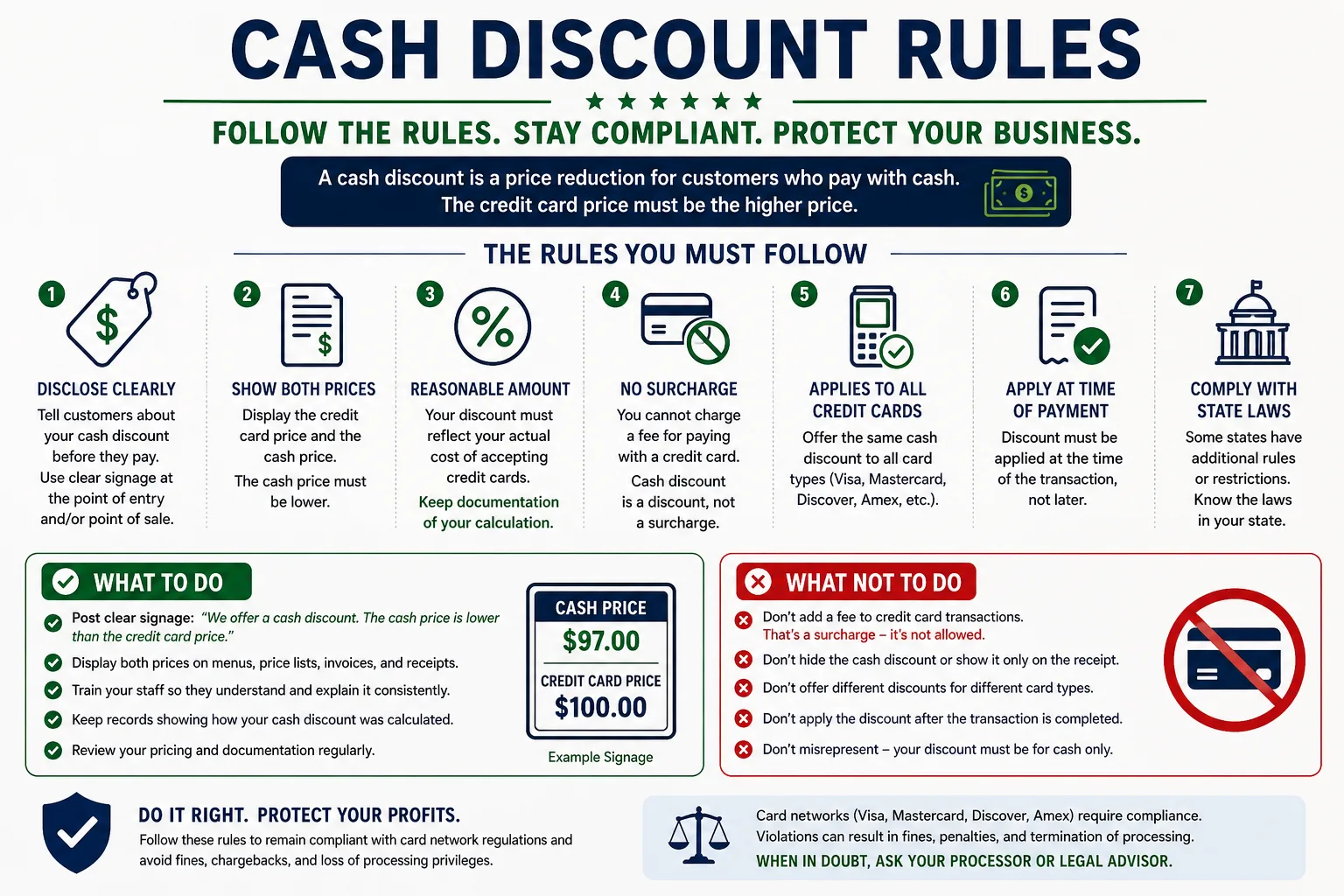
Cash Discount Do's and don'ts

A cash discount program is the one way of passing card costs along that is legal in all fifty states, requires no registration with Visa or Mastercard, and works even in Connecticut, Massachusetts, and Maine where surcharging is banned outright.

It is also the one most often set up incorrectly, and the mistake is not subtle. Get one structural detail backwards and your cash discount program is legally a surcharge, with every surcharge rule applying to you retroactively and none of them satisfied.

Here is how the model actually works, what makes it compliant, and the one number nobody helps you set correctly.

First, ask why your fees went up at all

If you are reading about cash discounting, there is usually one reason. Your credit card fees keep climbing, year after year, and at some point you decided you were done absorbing them.

So here is a question worth sitting with before you change how you price anything. Interchange, which is the actual core cost of accepting a card, has barely moved in fifteen years. The underlying cost of the thing you are buying is roughly what it was.

If interchange held steady and your bill did not, the increase came from somewhere else on the statement. Inflated fees charged above actual cost. Invented fees with official sounding names that no card network has ever heard of. Markup buried where it cannot be seen. Transactions downgrading because nobody optimized them. Processing fees on returns and voids that were never credited back to you.

40%
The average overbilling we find when we audit a merchant statement. Not the worst case we have seen. The average.

This matters more here than almost anywhere else, because a cash discount program does not reduce your processing cost. It moves it to your customers.

Move a number that is 40% too high and you have not solved anything. You have passed your processor’s overbilling on to the people who buy from you, and put your own name on the sign explaining it.

Audit first. Find out what accepting cards genuinely costs you once the statement is clean. Then decide whether you still want a cash discount program, and if you do, you will know exactly what number to build it around. Plenty of merchants get through that first step and discover the problem they were trying to solve has shrunk considerably.

What a cash discount program is

You post one price, and customers who pay with cash get a discount off it. That is the whole model. The posted price is the card price. Cash pays less.

Compare that with surcharging, where you post a price and add a fee when someone pays by credit. The customer ends up at a similar number either way, which is why merchants assume the two are interchangeable. Legally they are nothing alike, and the difference comes down to direction. A discount rewards one payment method. A surcharge penalizes another.

Federal law is why this matters. The Durbin Amendment, part of Dodd-Frank in 2010, explicitly protects a merchant’s right to offer a discount for cash. The card networks cannot contractually prohibit it.

That protection is what makes cash discounting available in all fifty states, including the ones where surcharging is off the table.

Cash discount, dual pricing, non-cash adjustment

Three terms, one family, and the distinctions are worth knowing because processors use them loosely.

Cash discount
One posted price, reduced at the register for cash. The classic structure, and the one the Durbin Amendment protects by name.
Dual pricing
Both prices shown side by side on the shelf tag, the menu, and the screen. Same legal footing, better execution. The customer sees both numbers before choosing, so nothing happens at the register that they did not already know about. This is the version that has taken over in the last couple of years, and in my view it is the right one.
Non-cash adjustment
A receipt label, not a program. It describes the line showing the difference between the two prices. Used carelessly, without a clearly posted card price behind it, it starts to look like a fee added to a cash price, which is the thing you are trying to avoid. Treat the phrase with caution.

The rule that decides whether you are compliant

Everything hinges on which price you post. Not what you call the program. Not what your signage says. Which number is on the tag.

Compliant: a cash discount

The shelf says $104. A customer paying cash gets $4 off and pays $100. You posted the card price and discounted from it. This is a discount, it is protected by federal law, and it needs no network registration.

Not compliant: a surcharge wearing a costume

The shelf says $100. A customer paying by card is charged $104 at the register. You posted the cash price and added a fee for cards. That is a surcharge, whatever the sign by the door calls it.

And now you are surcharging without the 30-day notice to your acquirer, without registration, possibly in a state that restricts it, and possibly on debit cards, which is never permitted. You did not choose to take on any of that. The pricing structure chose it for you.

Network auditors look at the posted price and the receipt, not the marketing. This is the single most common way a cash discount program gets reclassified, and merchants usually find out when the assessment arrives rather than when the mistake is made.

What compliance actually requires

There is no card brand registration and no waiting period, which is a real advantage. That does not mean there are no requirements.

The checklist

1. Post the card price as your regular price. Shelf tags, menus, price lists, your website. Everywhere a price appears, the card price is the one that appears.

2. Signage at the entrance and at the point of sale. Clearly readable, near the terminal, in normal type. Not a business card taped to the register.

3. The receipt has to show the math. The customer should be able to see the base price and the discount, or both prices, without doing arithmetic. Vague receipt labels create the exact ambiguity an auditor resolves against you.

4. Configure the POS to do it automatically. Manual application by staff produces inconsistency, and inconsistency is what makes a program look improvised.

5. Train the staff with one sentence. Something plain like: our prices include a discount for cash. Your team will explain this program hundreds of times a week, and they will explain it the way you taught them or the way they invented on the spot.

6. Apply it consistently across payment types. The discount is for cash. Everything else, credit and debit alike, pays the posted price. This is a meaningful difference from surcharging, which may never touch debit at all.

The disclosure trap that is not about card rules at all
State consumer protection law now reaches this too. California’s SB 478, effective July 2024, targets mandatory charges that appear late in a transaction. A properly run cash discount program is fine, because the posted price is the real price and the discount only lowers it. A program where the customer discovers the card price at the final screen is exactly the pattern that law exists to stop. Post both numbers early and this problem disappears.

The number nobody helps you set: your discount percentage

This is the part of the conversation that almost never happens, and it is where the money is.

Cash discount programs are typically set up at 3.5% or 4%. The logic offered is that this covers your processing cost. Fine. But what is your processing cost, actually?

Merchants who assume they are paying 3.5% to 4% are frequently paying closer to 2% once the statement is corrected. If your program is built on the assumption rather than the audited figure, the difference between those two numbers does not go to you. Your customers pay it, and it settles somewhere in the payments chain that is not your bank account.

Audit first, then set the discount. In that order, the number you post is the number it genuinely costs you, and you can defend it to any customer who asks.

In the other order, you are asking your customers to cover fees you were never supposed to be paying, and putting your own name on the request.

There is a competitive angle too. If the business across town runs 4% and you run 2%, that gap is printed on your shelf tags where every customer can see it. A cash discount program turns your processing costs into a published price, and published prices get compared.

When it is sold to you as zero fee processing

You will see cash discount programs marketed as free credit card processing, zero fee processing, or no fee processing. All three describe this model.

Nothing dishonest about the mechanics, and your net processing cost really can approach zero. But be clear with yourself about what happened: the cost did not disappear, it moved to your customer. That is a legitimate business decision, and plenty of merchants make it deliberately. Just make it with your eyes open, and make sure the amount you moved is the amount it actually costs.

How customers actually respond

I have written elsewhere about the research on surcharging, and it is not kind. Roughly two thirds of consumers say a surcharge lowers their opinion of the merchant, and a majority say they would switch to avoid one.

Dual pricing lands differently, and the reason is psychological rather than mathematical. Nothing is added to the customer’s total at the end. They saw both numbers on the way in and chose one. The same dollar difference feels like a choice they made instead of a penalty applied to them, and that distinction is most of the resentment.

That said, I would not tell you it is free of friction. You are still raising your card price, and some customers will notice and mind. The version that goes badly is always the one where the customer finds out at the register. The version that goes fine is the one where both prices were visible from the start and nobody was surprised by anything.

Where cash discounting sits among the other options

Cash discount or dual pricing
Legal in all fifty states. No registration, no advance notice. Applies to all non-cash payments including debit. The compliance burden is signage and structure rather than paperwork.
Surcharge
A percentage added for credit card use. Banned in several states, capped at 3% for Visa, never permitted on debit, and requires 30 days written notice to your acquirer. Considerably more machinery: the full surcharging guide.
Convenience fee and service fee
A flat dollar amount for using a payment channel outside your normal one, and a percentage-based program limited to government, education, and utility merchants. Both narrower than most people assume: surcharge vs. convenience fee, explained.

Frequently asked questions about cash discount programs

Is a cash discount program legal in all fifty states?

Yes. The Durbin Amendment protects a merchant’s right to offer a discount for cash, and the card networks cannot prohibit it by contract. That includes Connecticut, Massachusetts, and Maine, where surcharging is banned. State consumer protection and disclosure rules still apply to how you present prices, so structure and signage matter even though legality does not.

What is the difference between a cash discount and dual pricing?

Mostly presentation. A cash discount posts the card price and reduces it at the register for cash. Dual pricing shows both numbers side by side from the start. Same legal foundation, but dual pricing is easier to defend and easier for customers to accept, because nothing changes at the point of payment.

Do I have to register a cash discount program with Visa or Mastercard?

No. A properly structured cash discount or dual pricing program requires no card brand registration and no 30-day notice, which is one of its main practical advantages over surcharging. The catch is the word properly. If the structure is backwards, you are surcharging, and then all of that paperwork was required and none of it was done.

Does a cash discount apply to debit cards?

Yes, in the sense that debit customers pay the posted price like every other non-cash payment. This is one of the clearest advantages of the model, because surcharging debit is prohibited nationwide with no exceptions. A discount for cash does not run into that problem, since you are lowering a price rather than adding a fee to a card.

What percentage should my cash discount be?

It should match what accepting cards actually costs you, which means finding that number before you set the program up rather than accepting the 3.5% or 4% default. Merchants who audit first often discover their real cost is closer to 2%. Setting the discount above your true cost means your customers are covering more than your processing, and you are the one whose name is on the sign.

Is cash discounting the same as free credit card processing?

Those are marketing names for this model. Your net processing cost can genuinely approach zero, so the claim is not false. But the fee did not vanish, it moved to your customers. Decide that deliberately, and make sure the amount you moved matches what it truly costs you.

What is the most common compliance mistake?

Posting the cash price as the regular price and adding a charge for card users. That is a surcharge by structure regardless of what the program is called, and it exposes you to surcharge rules you have not followed. The second most common is a receipt that does not clearly show the base price and the discount, which leaves an auditor to interpret an ambiguity that you would rather not have created.

The part they leave off the brochure
Your processor has a score. Do you know it?

If someone is setting up a cash discount program on your account, their record is worth reading first. The Processor Scoreboard rates more than two dozen major processors from 0 to 100 on the documented record, sorted worst first, with the evidence behind every point deducted. No processor pays to be listed, and none can pay to be removed.

See Your Processor’s Score

Set your discount at your real cost, not a default

Send us your most recent processing statement. We will show you exactly what accepting cards costs you today, which is the only defensible number to build a cash discount program around. It is free, and it takes about five minutes of your time.

Get My Free Audit

Or call us at 800-672-1292

A necessary note. This article is general information, not legal advice, and I am not an attorney. Card network rules are updated on their own schedule, and state consumer protection and pricing disclosure law varies. Confirm your position with counsel licensed in your state and with your acquirer before implementing any pricing program. Rules described here are current as of August 2026.

Read More

Check out our other insights here

Warning If You Use Bank of America For Credit Card Processing

View

Do You Have Risk Fees On Your Credit Card Processing Statement?

View

Want to talk?

As seen on