




Chat with us, powered by LiveChat

Is Your Credit Card Processor Keeping Your Rebates?

Is your credit card processor keeping your rebates? Most likely, yes. I would say 95% or more of merchants are not getting theirs. If you are Walmart, you are probably fine. For everyone else, read on.

The short version
When you refund a customer, the card networks give the interchange back. It goes to your processor. Your processor is supposed to pass it to you. Most merchants have never been told this happens at all, which is exactly why it so often does not.

A low discount rate makes this more likely, not less

If you have a low discount rate, say 0.05% or less, you are at high risk of your rebates being kept. That sounds backwards until you think about where the money has to come from.

Think of it like a grocery store. You tell the manager you are leaving because the milk is too expensive. If that manager came out of the credit card processing business, he says “no problem” and marks the milk down to the cheapest in town. Then quietly raises the price of everything else in the store.

Merchants become obsessed with the discount rate and never learn about the other hundred ways a processor can overbill them. That is the whole game, and it is covered in more detail in how you can have the lowest discount rate and the worst deal.

How interchange rebates actually work

When merchants post refunds, the processing networks (Visa, Mastercard and Discover) return the interchange to the processor.

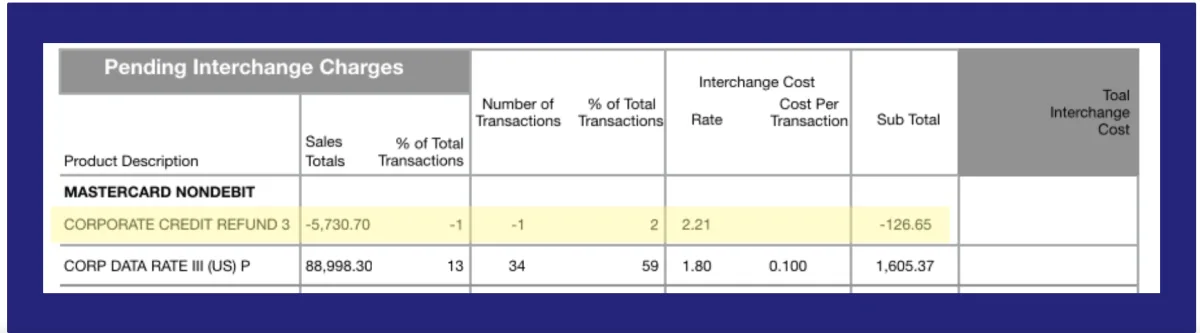
The merchant below had $5,730.70 in returns, and the processor properly credited them the 2.21% interchange rebate, shown here as a Credit Voucher.

Merchant statement section showing a Credit Voucher line crediting back 2.21 percent interchange on 5,730.70 dollars of returns
What it looks like when the rebate is passed through correctly. We cannot show you a statement that is missing it, because a missing line is simply not there.

Because processors know most merchants have no idea this credit is owed to them, they most often just keep it.

How to check your own statement

This is a two minute check and it does not require understanding the rest of the statement.

  • Find your returns. Your statement will show total credits or returns for the month as a dollar figure.
  • Look for a matching credit in the interchange section. It may be called Credit Voucher, Interchange Rebate, or something else entirely. Naming is not standardised, which is part of the problem.
  • If you posted refunds and no credit appears anywhere, ask. The question to put to your processor is simple: where is the interchange returned on my credits?

For a rough sense of scale, multiply your annual returns by your average interchange rate. That is the order of magnitude at stake. For a business with few refunds it is noise. For one with heavy returns it is not.

Frequently asked questions

What is an interchange rebate?

When you refund a customer, the card networks return the interchange they originally charged on that sale. That returned interchange is the rebate. It goes back to your processor first, and your processor is supposed to pass it on to you as a credit on your statement.

How do I know if I am getting my interchange rebates?

Find your total returns or credits for the month, then look for a corresponding credit in the interchange section of the statement. It may be labelled Credit Voucher, Interchange Rebate or something similar. If you posted refunds and there is no credit anywhere against them, you are probably not receiving the rebate.

What is a Credit Voucher on a merchant statement?

It is one of the names processors use for the interchange returned to you when a sale is refunded. Different processors label it differently, which is part of why it goes unnoticed.

Does this matter if I rarely issue refunds?

Not much. The rebate is proportional to your returns, so a business with almost no refunds has little at stake. For merchants with heavy returns it can reach tens of thousands of dollars a year.

Find out whether yours are being passed through
Send us a recent statement. Checking the interchange on your credits is one of the first things we look at.

Get Your Free Audit

Get Your Free Audit  |  Schedule A Free Consultation

Subscribe to insights  |  Read more Insights  |  Submit an article idea

Keeping Your Debit Rebates 

The Durbin Swipe Fee Amendment requires* issuing banks** to reduce the Interchange fee to 0.05%*** to the processor. However, there’s nothing in the law that actually requires the lower fees get passed on to the merchant. I wrote an article on this for Credit Today titled, “Is This A Major Screw-up Or Cover-up?” Why pass a law to make the issuing bank lower their fees to the credit card processor, but not require the processor to pass those lower fees on to the merchant? 

Let me break this down a little plainer. I’m not specifically picking on Chase Bank, but I will use them in this example. Chase Bank (who is the card issuer and receives the interchange fees) has to lower their interchange fees to Chase Paymentech (their credit card processing division) – aka “the processor.” However, Chase Paymentech is not required to pass the lower interchange fee onto the merchant. 

Therefore, what really changed? Well, the issuer (Chase Bank) makes less, but Chase Paymentech (the processor) makes more! That is, unless they decide out of the goodness of their heart, to pass the lower interchange fees to the merchant. Again, if they want to, not because they are required.

At this point, most merchants are at least somewhat aware of this law; however, it can be time consuming to go through every line item on your statement and if the processor does not want to pass the lower interchange fees on, they won’t provide enough detail to the merchant so the merchant won’t know if it was a regulated debit or not. Worse yet, many credit card processors will not break debit transactions out, and charge the merchant the same rate as a credit card. If a business does a lot of debit transactions this can be a real profit center for the credit card processor. 

It is impossible to show all the different ways credit card processors hide debit fees, but the image below shows what you should see.  


* Signed into law 07/21/10 and effective 10/01/11 amended the Dodd-Frank Wall Street Reform and Consumer Protection Act.

** Debit Cards issued by banks with less than $10 billion in assets are excluded (e.g. many credit unions and small local banks). These cards make up a very small percentage of all debit transactions, and while the Interchange is not 0.05%, it is still much less depending on how the card is processed, swiped, keyed, etc.

*** Visa Credit Interchange has a $0.10 fee, and the Visa Debit Interchange is $0.21, or $0.22 if it has fraud protection. For the sake of simplicity, those differences are not included in the above example. For merchants with a $500 average transaction, the above example would be off by 0.01%.

The easiest way to find out if your credit card processor is keeping your rebates is to take advantage of our Free Audit.

Also, you can find more information on how to protect yourself and your hard-earned profits in my newest book, “The Great American Heist – How Credit Card Processors Steal Businesses’ Profits.”


Subscribe to insights  –  Read more Insights   –  Submit an article idea


Read More

Check out our other insights here.

Do You Have Risk Fees On Your Credit Card Processing Statement?

Man reading credit card processing statement

Do you have a “Risk Fee” on your credit card processing statement?

No? Good. You are luckier than a lot of merchants, and you should keep reading anyway.

View

Is Your Money Safe In A Bank?

If I asked whether your money is safer in a box on your back porch or in the bank, you would say the bank and give me an eye roll.

View

Want to talk?

As seen on