

Chat with us, powered by LiveChat

Case Study – When Your Processor Promises to Make Things Right

A merchant found out they were being overbilled, confronted their processor, and accepted an apology and a promise to put it right. A year later they had paid over $7,000 more than the year before, on almost identical volume. This is how that happened.

The one line version
The processor kept every promise it made, and the merchant still ended up paying eight times the rate they thought they had agreed to.

The problem, as the merchant saw it

  • At the start, the merchant did not think they had a problem at all. They felt they were getting a good deal.
  • Their trade association had told them the processor was vetted and came highly recommended.
  • The statements were easy to read. Short, clean, no walls of data they could not understand.

That third point is the one to sit with. An easy statement felt like a sign of a good processor. It was the opposite.

What the audit found

  • The processor was bundling fees. The statement was simple to read precisely because it disclosed almost nothing.
  • The discount rate was not disclosed at all.
  • There was no interchange management, again because there was no disclosure to manage against.
  • The processor was endorsed by the merchant’s association, and that endorsement did its job. It bought unchecked, unvalidated trust.
  • The processor was paying the association a revenue share for the endorsement. Splitting the plunder, if you will.

The processor promises to make things right

  • The processor apologised, agreed with the audit findings, and said it would put things right.
  • It agreed to disclose all fees going forward.
  • It agreed to disclose the discount rate.
  • It agreed to 7 basis points, matching the competitive bid we had obtained.
  • It did not offer to return any of the money already overbilled.

On the strength of that apology the merchant decided to stay and let the processor fix it. Nothing was vetted or validated by a third party, and no contract went past an attorney who specialises in merchant processing agreements. The processor advised them not to waste more money bringing in a third party. They took them at their word.

One year later

The merchant called us back, unhappy. The processor, they said, had fixed everything we had identified. And on paper it had.

The new statement showed a discount rate of 7 basis points, exactly as promised. Every fee was disclosed, exactly as promised. And they had paid over $7,000 more than the previous year on nearly identical volume.

Where the money actually went

Two things had been added.

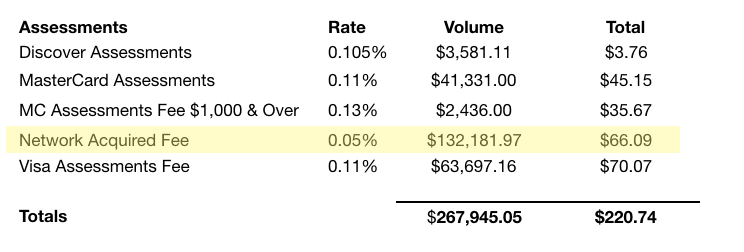
First, a fee named to look like somebody else’s. The processor invented a charge called “Network Acquired Fee”. The real fee is Visa’s “Fixed Network Acquirer Fee”. Close, but not the same thing.

It was placed under Assessments, which is the section where the networks list their own charges, so it read as though it came from Visa or Mastercard. Look closely and there is no network name in front of it, which is the tell.

Merchant statement showing a Network Acquired Fee listed under Assessments with no card network name in front of it
A made-up fee, filed under Assessments so it looks like a network charge. Worth 5 basis points.

Second, enhanced billing. This is where the processor adds a surcharge on top of the actual interchange rate. It is common because it is close to impossible to spot from the statement alone.

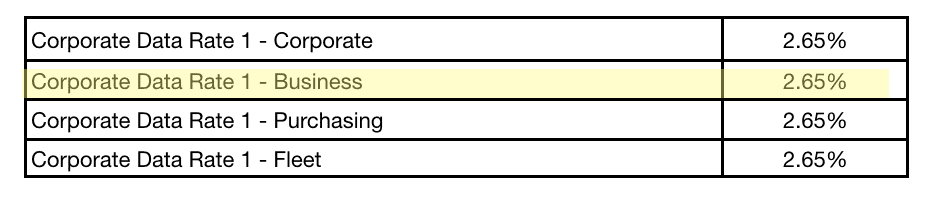
In this case the merchant had 17 transactions settling as MC COML DATA RATE 1 BUS. Divide the $220 charged by the $7,077 of volume and the processor was charging 3.11% on those transactions. Mastercard’s own published rate for a Data Rate I transaction is 2.65%. The processor was enhancing the interchange by 46 basis points.

Statement detail showing 17 transactions at MC COML DATA RATE 1 BUS charged 220 dollars on 7,077 dollars of volume, an effective 3.11 percent
What the merchant was charged: 3.11% on those transactions.
Mastercard published interchange rate sheet showing Data Rate I at 2.65 percent
What Mastercard actually charges for that category: 2.65%. The 46 basis point gap is the enhancement.
The real rate
7 basis points disclosed discount rate
+ 5 basis points invented “Network Acquired Fee”
+ 46 basis points interchange enhancement
= 58 basis points
Against the 7 basis points the merchant believed they were paying, on a statement where every fee was disclosed exactly as promised.

The merchant only caught it at year end, comparing twelve months of fees against the previous twelve. Volumes happened to be almost identical, which is the only reason the difference stood out. Had they processed noticeably more or less that year, they would probably never have noticed.

How could this happen?

  • The money buys trust. Our own audits lead us to estimate that merchants are overbilled somewhere between $100 billion and $200 billion a year. That is weAudit’s estimate rather than a published statistic, and it covers avoidable interchange losses as well as markup. Profits at that scale buy fame, brand recognition, endorsements and trust. Even blind trust.
  • There is no regulation or government oversight of the kind that would stop a processor inventing fees, hiding fees and inflating fees.
  • The processor talked the merchant out of a second opinion. Just trust us, and trust the association.
  • The association takes a revenue share and never asks the obvious question: if the processor is giving our members the best deal, how can it also afford to give us this much money?
  • Associations are not payments experts. An association may negotiate brilliantly on the things it buys often. Merchant processing is not one of them, and their members are left exposed.
  • “I might be paying a little more, but I am supporting my association.” The largest revenue share we have seen is 50%, so for every $100 of overbilling, $50 reaches the association. Most are nearer 10%, meaning $10 of every $100. The rest is not support. It is margin.

The processors get rich. The merchants and the associations are both taken advantage of.

What this case should change

An apology is not a remedy, and a disclosed statement is not automatically an honest one. Every promise here was kept to the letter, and the merchant still paid eight times the rate they thought they had agreed.

If a processor agrees to put something right, get the new pricing validated by someone who is not them, and compare the next twelve statements rather than the next one. Our statement decoder covers the line items, and why monitoring is critical explains why the check has to be monthly rather than annual.

Has your processor promised to make things right?
Send us the statement from after they fixed it. That is the one worth checking.

Get Your Free Audit

Get Your Free Audit  |  Schedule A Free Consultation

Subscribe to insights  |  Read more Insights  |  Submit an article idea

Read More

Check out our other insights here.

Is Your Money Safe In A Bank?

If I asked whether your money is safer in a box on your back porch or in the bank, you would say the bank and give me an eye roll.

View

How Can I Have The Lowest Discount Rate and The Worst Deal?

Credit card processors know that merchants look at two numbers: the discount rate and the transaction fee. So those are the two numbers they compete on. Which is how a merchant ends up holding the lowest discount rate any processor in the market will quote, and one of the worst deals on the street, at […]


View

Want to talk?

As seen on