


Chat with us, powered by LiveChat

Credit Card Surcharge Laws by State: The 2026 Rules

Credit-Card-Surcharge-rules-by-State-2026.

Before the rules, our position.

We do not recommend surcharging. Not one of the 500 largest companies in America adds a credit card surcharge, the consumer research is uniformly bad, and in our experience most merchants who surcharge are passing along fees they were never supposed to be paying in the first place. We have made that case at length in our full guide to credit card surcharging.

This page exists anyway, because some businesses are going to surcharge regardless, and a merchant doing it blind is worse off than a merchant doing it correctly. If you have already decided, read how to do it without the risk before you set anything up.

Credit card surcharge laws are only one of three rulebooks that govern surcharging in the United States. The others are the card network rules and your own merchant agreement. All three apply at the same time, and the strictest one wins.

Most merchants only ever hear about one of them, usually from the processor selling them the program. Here is the whole picture, current as of August 2026.

The rules that apply everywhere

These come from the card networks and federal law. No state overrides them, and no processor can waive them on your behalf.

The absolute prohibition

You may never surcharge a debit card, a prepaid card, or a gift card. Not in any state, not with any processor, not under any circumstance. This is prohibited nationwide under the Durbin Amendment and by card network rules, and running the card as credit does not create an exception. Texas and Maine also ban it under state law, and Louisiana’s own debit surcharge ban takes effect August 1, 2026. This is the single most common violation we find, and it is almost always a terminal configuration nobody checked rather than a decision anyone made.

The caps, brand by brand

Visa: 3%
Reduced from 4% in April 2023. Plenty of programs are still running on the old number.
Mastercard: 4%
A higher ceiling on paper, but the cost of acceptance rule below still binds.
American Express: no separate cap
Non-discrimination rules effectively tie you to the lowest limit among the brands you accept.
Discover: 4%
Follows the general structure, with actual cost as the binding constraint.

Accept all four brands, as nearly every merchant does, and 3% is your practical ceiling.

Then the rule that beats every number above: the surcharge may never exceed your actual cost of acceptance. If your true cost is 2.4%, your cap is 2.4%, and a flat 3% is a violation no matter what the brand cap says.

Notice, disclosure, and consistency

30 days written notice to your acquirer before the first surcharged transaction, stating your business name and address, the amount, whether you are surcharging at brand or product level, and any processor or payment facilitator involved. Visa’s October 2025 Core Rules refresh kept this requirement in place. Skipping it makes an otherwise compliant program non-compliant.

Disclosure in four places: at the point of entry or on your website before the cart, at the point of sale near the terminal, before the transaction completes so the customer can still choose another payment method, and on the receipt as its own separate line.

No favorites between networks. If a competing brand you accept prohibits surcharging, you cannot surcharge Visa either. Picking the expensive network and leaving the others alone is not permitted.

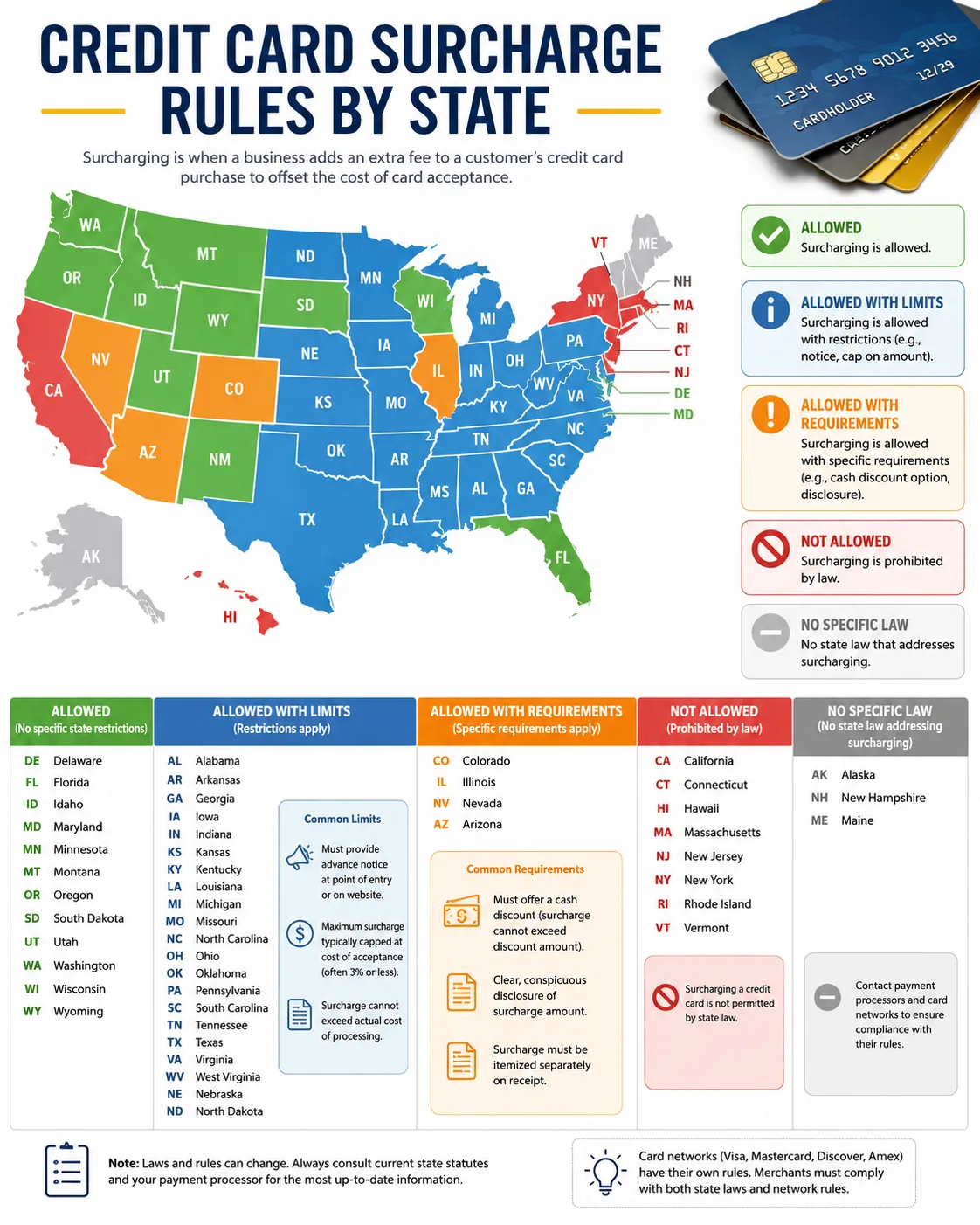
Credit card surcharge laws by state

Credit card surcharge laws vary by state, and this is where it gets genuinely messy. We would rather be honest about how messy than hand you a tidy table that gives false confidence. State surcharge law is a mix of active bans, bans that courts have struck down but legislatures never repealed, and caps that sit below the network maximum.

Banned and actively enforced
Connecticut, Massachusetts, Maine, and Puerto Rico.
Massachusetts and Connecticut have the oldest and most consistently enforced bans in the country. Cash discount programs generally remain available in these states, which is how most merchants there recover card costs instead.
Banned on paper, struck down in court, enforcement unclear
California, Texas, Oklahoma, and Kansas.
All four have surcharge bans in statute that federal courts have ruled unconstitutional on First Amendment grounds, following the reasoning in Expressions Hair Design v. Schneiderman. The statutes are still on the books, and enforcement posture varies.
Texas is the sharpest example: the Attorney General has issued an opinion that the state’s ban is enforceable regardless. This is exactly the kind of gray zone where a merchant gets confident and then gets a letter.
Legal, but capped below the network maximum
Colorado caps surcharges at 2%.
New York, New Jersey, Nevada, South Dakota, Nebraska, and Georgia limit the surcharge to the merchant’s actual cost of acceptance. For most merchants that lands under 3% anyway, which means the state cap and the network rule arrive at the same place.
New York and Maine impose stricter disclosure than most. Since February 2024, New York requires the total price a card customer will pay to be posted, not just the percentage, and both states expect the cash price and the card price shown side by side.
Everywhere else
Generally permitted, subject entirely to the network rules above. That does not mean unregulated. It means the card brand requirements, the cost of acceptance ceiling, the 30-day notice, and the disclosure obligations are doing all of the work, and every one of them still applies.

A word about the table you did not get. While researching this, we pulled six published state-by-state surcharging guides, all written by payments companies, all updated in 2026. They contradict each other on California. Some list it as banned. Others say surcharging with proper disclosure is now generally permitted there.

If six payments industry sources cannot agree on the most populous state in the country, that tells you what you need to know about setting this up from a web page. Including this one. Talk to an attorney licensed in your state before you start.

What non-compliance actually costs

Merchants usually expect a warning letter. Visa’s non-compliance structure, as summarized by the law firm ArentFox Schiff from Visa’s own Core Rules, escalates on a schedule instead.

First identified
An immediate $1,000 fine, plus a request for a remediation plan.
Continuing violation
Fines increase and compound, reaching up to $150,000 once 150 calendar days have passed without correction.
After 180 days
Another $25,000 per month until the violation is fixed.
Worst case
Loss of surcharging privileges, or disqualification from accepting Visa cards at all.

In December 2023 a payments processor warned its sales partners that merchant clients failing to comply with Visa’s surcharge rules could face fines between $50,000 and $1 million, and Payments Dive reported Visa was stepping up enforcement. That range has been repeated across the industry ever since.

Enforcement is not by complaint alone. Visa and Mastercard use secret shoppers to check surcharge compliance in the field, and any customer can report a merchant through Visa’s rules complaint form. You will not necessarily know you are being reviewed until the assessment arrives.

And the fine may not stop with the networks
Every merchant agreement we have audited contains an indemnity clause shielding the processor from liability for the guidance it gives you. If your processor sets the program up incorrectly and the networks fine both of you, that clause typically lets them pass their penalty straight through to your account. You can be hit twice for advice you did not write.

What the 2026 settlement changes

The Visa and Mastercard interchange settlement received preliminary approval from U.S. District Judge Brian Cogan on June 9, 2026. If it survives to final approval, merchants would be able to surcharge at either the brand level or the product level, though not both for the same network. In plain terms, you could target only the expensive premium rewards cards rather than every credit card you take.

The caps, the cost of acceptance ceiling, the disclosure obligations, and the 30-day notice all remain.

Do not build anything on this yet

Preliminary approval is not final approval. The National Retail Federation and the National Association of Convenience Stores both called the credit card market broken and said the revised terms do not fix it. NACS has said it will appeal to the Second Circuit if final approval is granted, and some analysts think this may not be fully resolved until 2029.

Whatever the settlement ultimately permits will apply network-wide, regardless of whose paper you are on. Any salesperson using it as a reason to move your account is selling, not advising.

If you are going to do it anyway

We have said where we stand, and we are not going to lecture you and walk away. If the decision is made, the sequence matters more than anything else on this page.

Audit first, surcharge second. Your legal ceiling is your actual cost of acceptance. Surcharge before you clean up the statement and you are not passing along the cost of accepting cards. You are passing your processor’s markup to your own customers, with your name on the sign explaining it. After a proper audit most merchants find their true cost lands nearer 2% than 3%, which undercuts every competitor charging a flat 3% and keeps you inside the legal cap at the same time.

The full version of that argument, with the four advantages it produces

Including how to move the compliance risk off your desk, what to get in writing from a specialty firm, and why doing it in the other order inverts every one of those advantages.

If you are going to surcharge, do it without the risk

Frequently asked questions

What are the credit card surcharge laws by state?

Credit card surcharge laws fall into three groups. Connecticut, Massachusetts, Maine, and Puerto Rico enforce outright bans. California, Texas, Oklahoma, and Kansas have bans in statute that federal courts ruled unconstitutional, leaving genuine ambiguity, and in Texas the Attorney General has said the ban is enforceable anyway. Because published guides openly disagree on some of these, confirm with counsel licensed where you operate before you start.

What is the maximum credit card surcharge allowed?

Whichever of three numbers is lowest: your actual cost of acceptance, the network cap of 3% for Visa and 4% for Mastercard, and your state’s cap. Accept both major networks and 3% is your practical ceiling. Colorado caps at 2%. Several states limit you to your true cost, which for most merchants is under 3% regardless.

Can I surcharge a debit card?

No. Never, in any state, under any circumstances, and the same applies to prepaid and gift cards. Running the card as credit does not create an exception. This is the violation most likely to be sitting in your terminal configuration right now without your knowledge.

Do I have to notify anyone before I start?

Yes. At least 30 days written notice to your acquirer before the first surcharged transaction, including your business name and address, the surcharge amount, whether you are surcharging at brand or product level, and any processor or payment facilitator involved. Skipping this makes an otherwise compliant program non-compliant.

What if my state allows a higher surcharge than my actual cost?

Your cost of acceptance still governs. The network rule that a surcharge may never exceed your true cost applies on top of every state cap and every brand ceiling. A merchant charging 3% on a 2.1% cost is in violation even in a state with no cap at all.

Is a cash discount program a way around the state bans?

It is a different model rather than a workaround, and it is permitted in all fifty states including the ones that ban surcharging. The requirement is structural: the posted price must be the card price, with cash customers receiving a discount from it. Post the cash price and add a fee for cards and you have a surcharge regardless of the label. Full detail in our guide to cash discount programs.

The part they leave off the brochure
Your processor has a score. Do you know it?

If your processor is the one encouraging you to surcharge, their record is worth reading first. The Processor Scoreboard rates more than two dozen major processors from 0 to 100 on the documented record, sorted worst first, with the evidence behind every point deducted. No processor pays to be listed, and none can pay to be removed.

See Your Processor’s Score

Find your cost of acceptance before you set a rate

It is the legal ceiling on any surcharge you impose, and most merchants have never been told what theirs actually is. Send us your most recent processing statement and we will show you. Free, no obligation, about five minutes of your time.

Get My Free Audit

Or call us at 800-672-1292

A necessary note. This page is general information, not legal advice, and we are not attorneys. Surcharging law varies by state, changes frequently, and is currently unsettled in several jurisdictions. Card network rules are updated on their own schedule. Confirm your position with counsel licensed in your state and with your acquirer before implementing any surcharge program. Fine schedules are drawn from published summaries of Visa’s Core Rules and from industry reporting. Current as of August 2026.

Read More

Check out our other insights here

Warning If You Use Bank of America For Credit Card Processing

View

Do You Have Risk Fees On Your Credit Card Processing Statement?

Man reading credit card processing statement

View

Want to talk?

As seen on